I'm an everyday walker, a passionate learner, and en educator creating experiences that grow eco and digital literacy. I'm living with stage IV colorectal cancer and type 1 diabetes, hoping to eek out as much life as possible before the cruel world takes me.
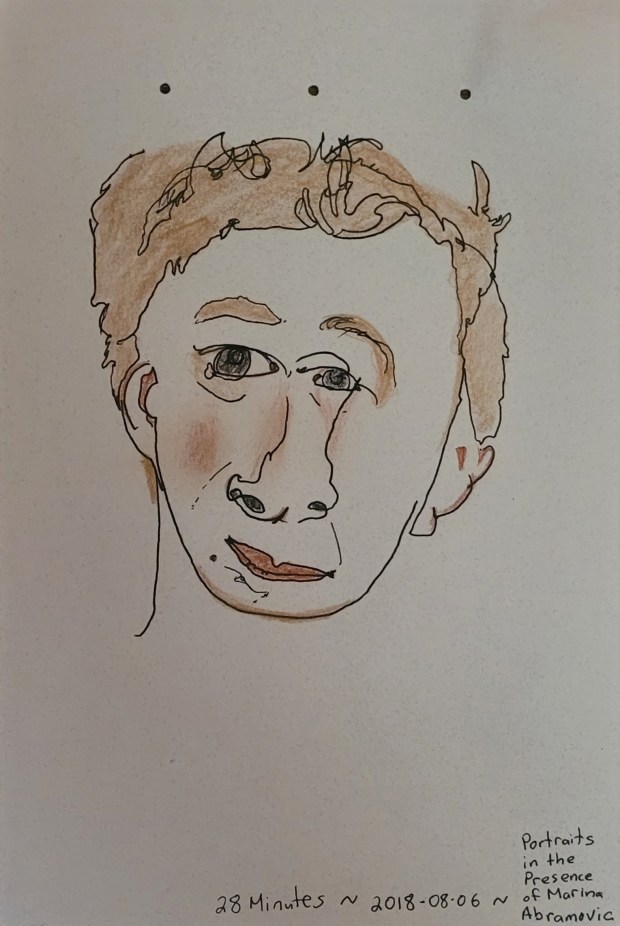
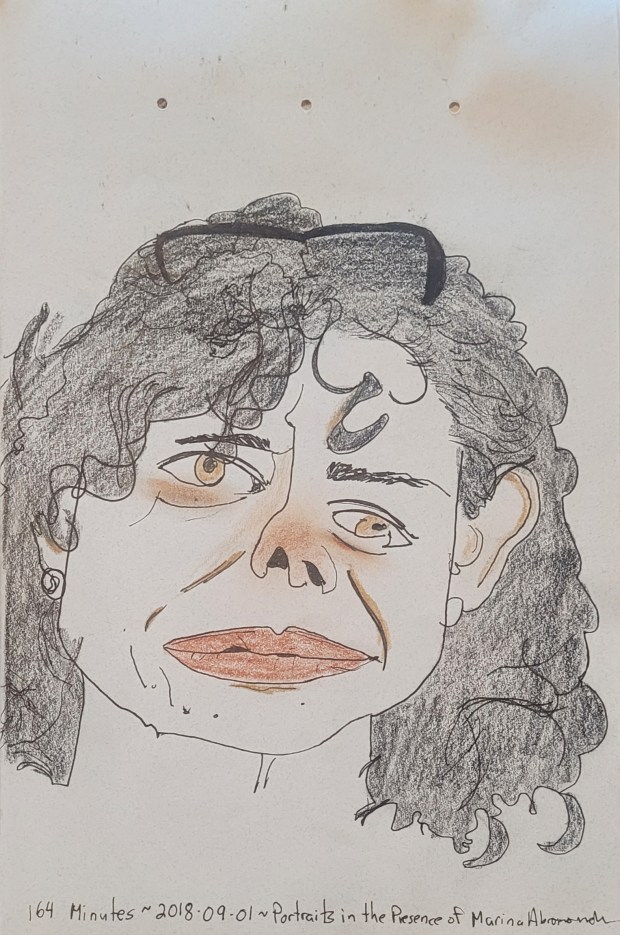
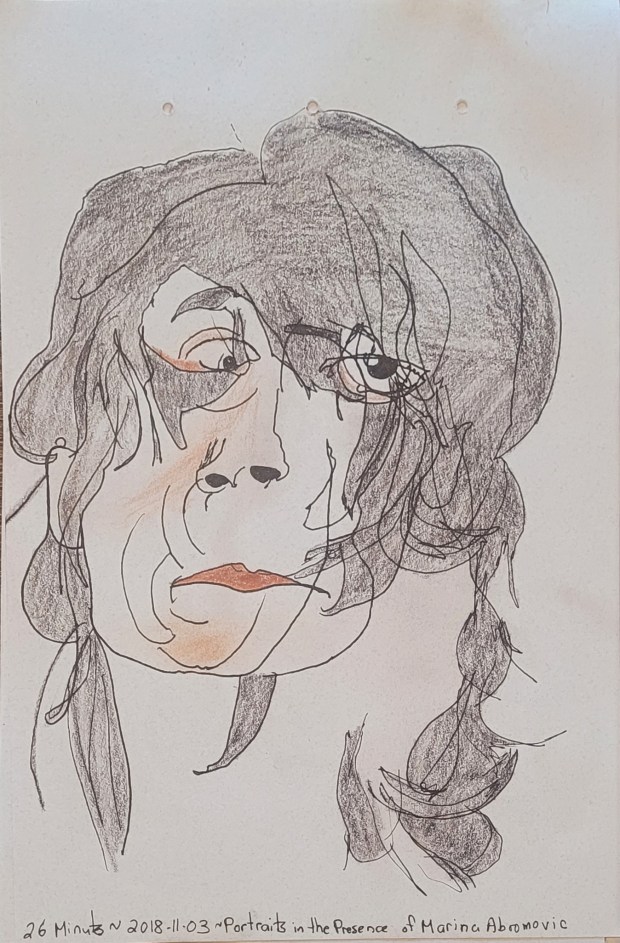
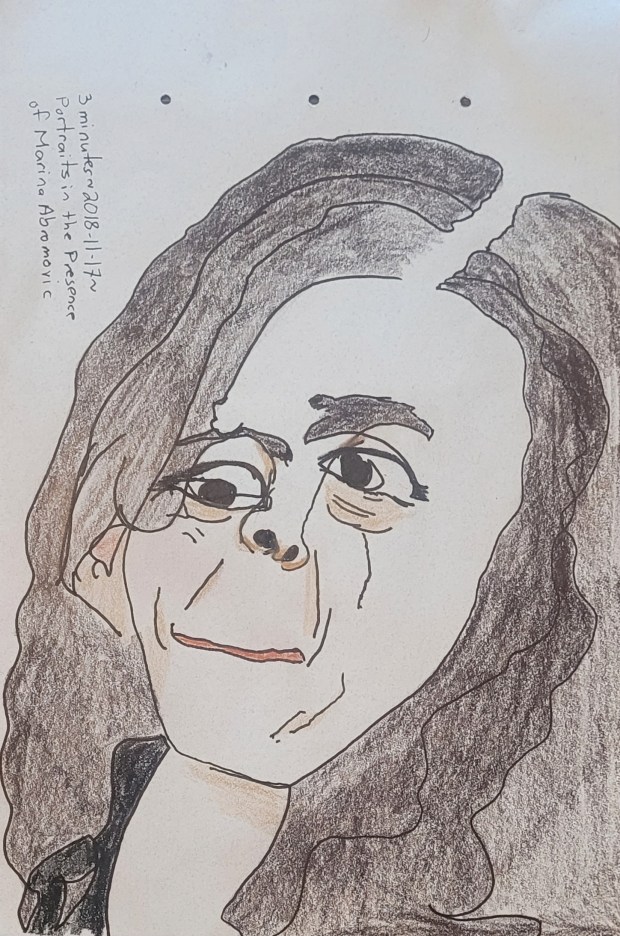
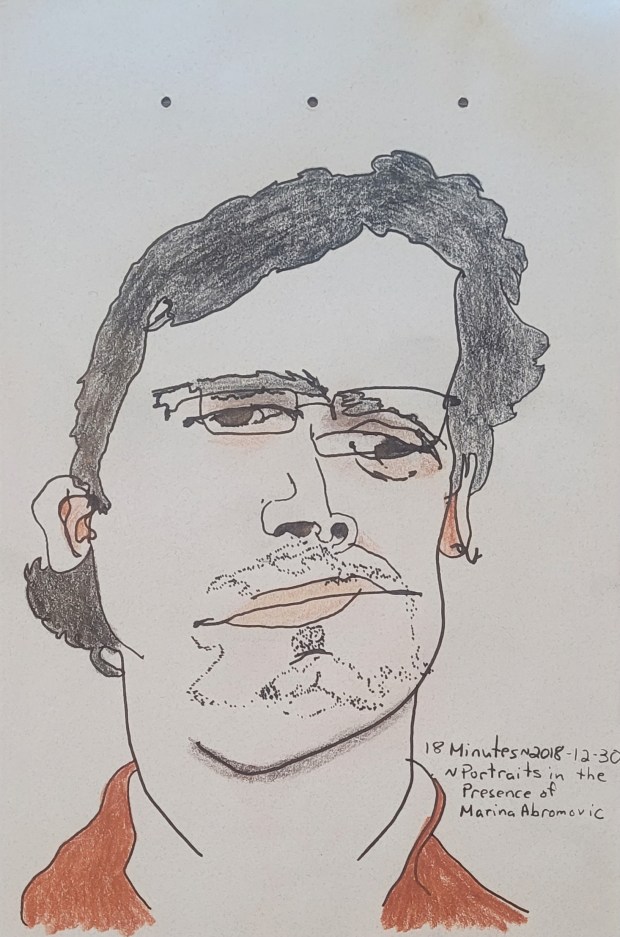
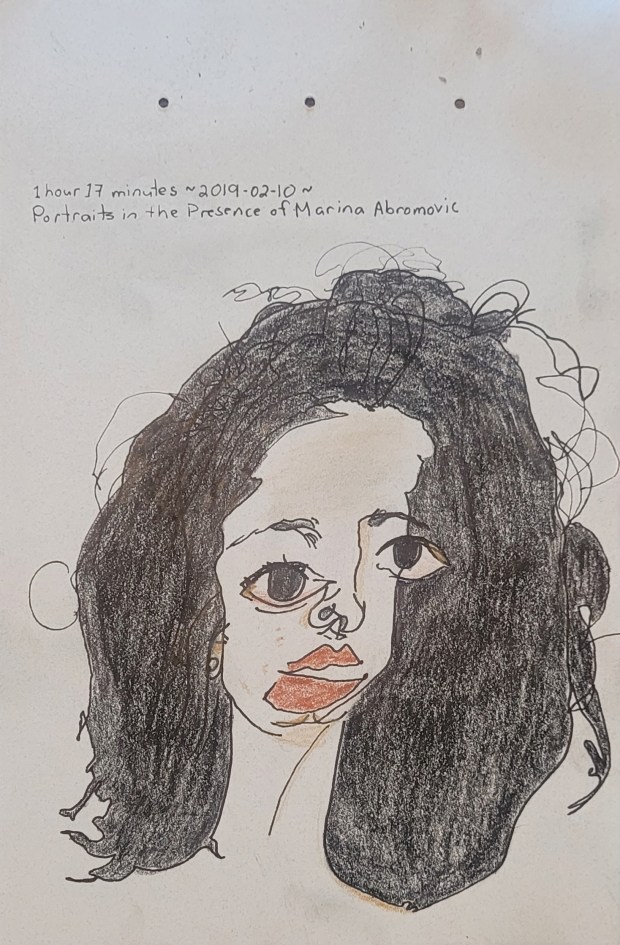
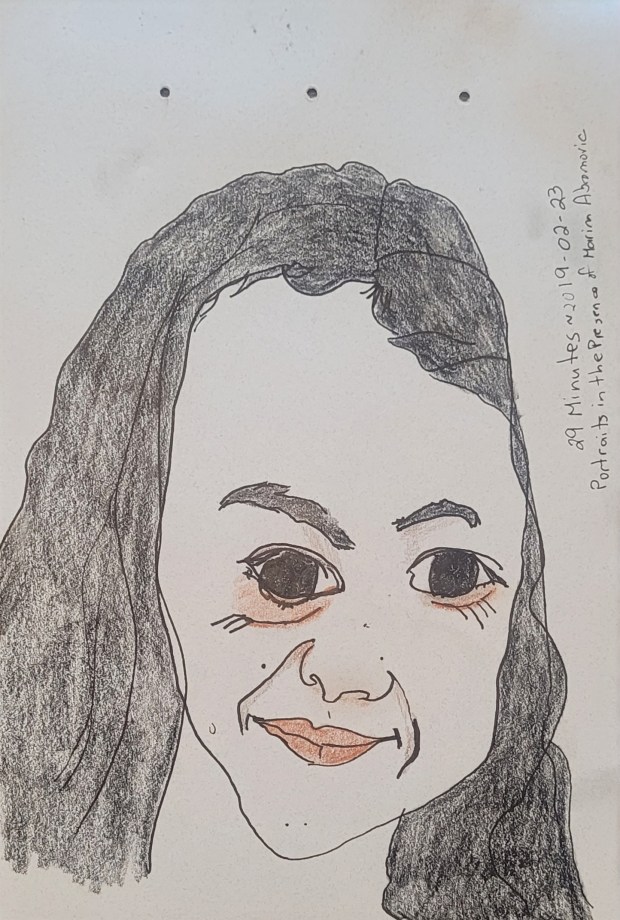
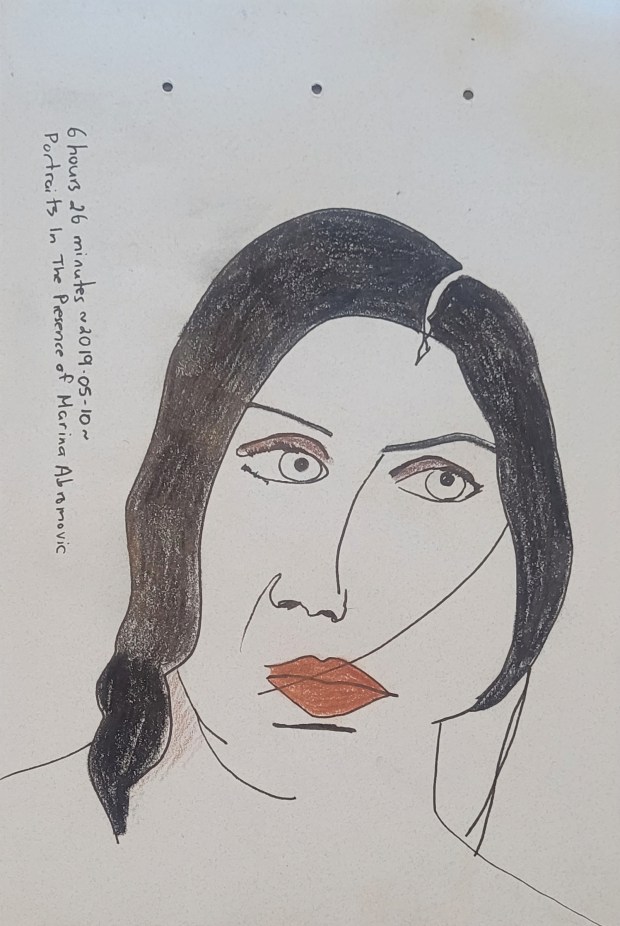
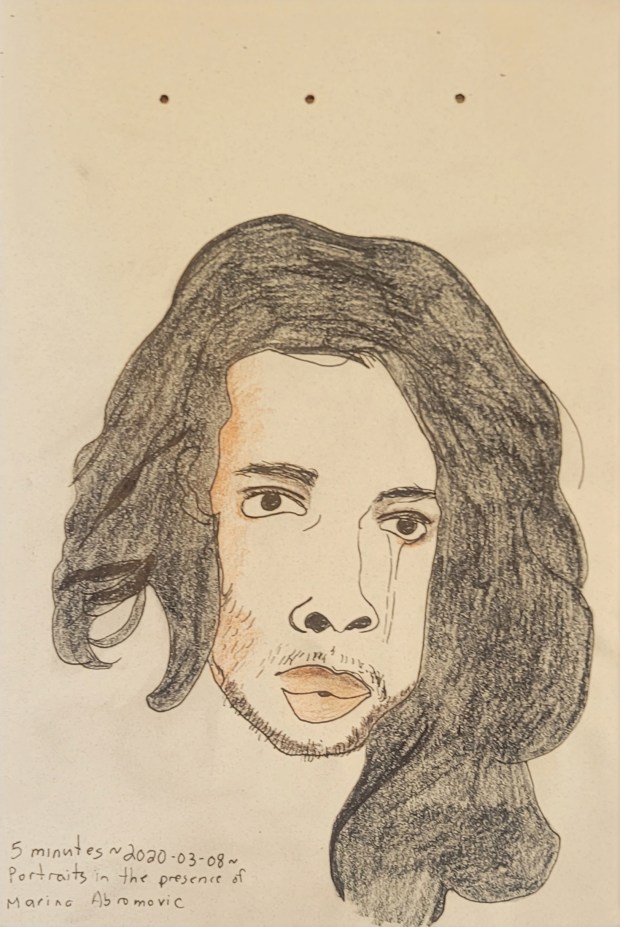
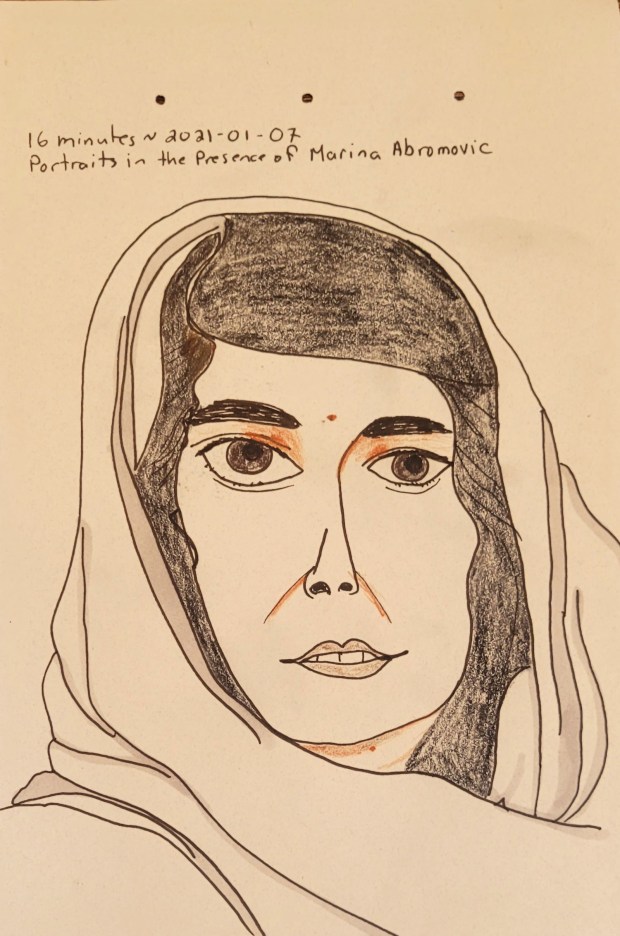
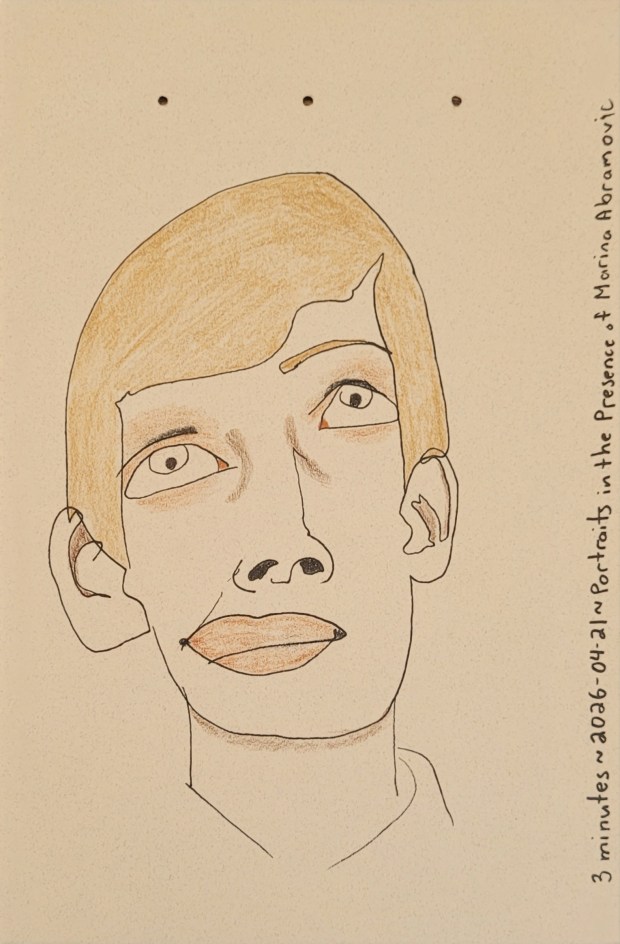
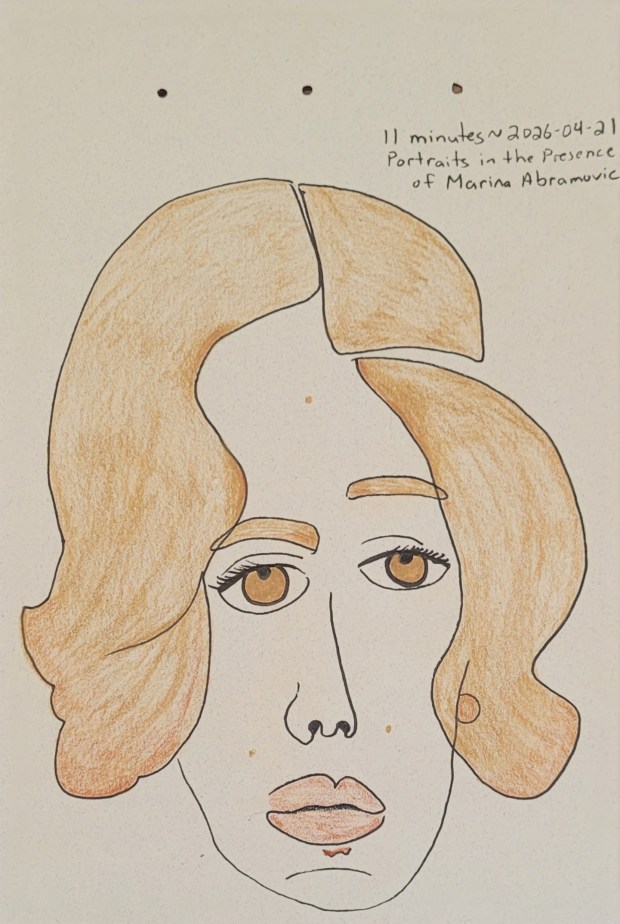
In 2018, as a means to practice sketching, I started a project where I did blind, continuous line drawings of the portraits taken of people after they attended The Artist is Present. Admittedly, I broke the continuity of the lines a lot, but I tried to embody the spirit of the practice—to feel my way through the space on the page rather than relying on my site.
The Artist is Present was the titular performance art piece debuted at the MOMA in New York in Spring 2010 as part of a retrospective of Abramović’s work. In the piece, Marina Abramović sat at a simple table in the atrium of MOMA while spectators sat silently opposite her and maintained eye contact with the artist.
Photographer Marco Anelli captured 1,545 portraits of spectators during the run of the performance, 260 of which are featured on his website. There is scant information about the subject of the portrait, save for a portrait number and how long they sat with Abramović, the latter of which I’ve used to title my drawings.
Over the years, I’ve done only 12 drawings of the portraits. I enjoy that the result mimics the way a message gets twisted in a game of Telephone, making more obvious the fact that this is art made from art made from art.
28 minutes
164 minutes
26 minutes
3 minutes
18 minutes
1 hour 17 minutes
29 minutes
6 hours 26 minutes
5 minutes
16 minutes
3 minutes
11 minutes
As a strange aside, the first drawing I did on August 6th, 2018 is of Brian. Brian has, what he calls, a bit of a “curse” of going viral on the internet. I heard about this guy on an episode of Reply All, where he talks about all the strange places his face has shown up and gotten him in trouble.
Anyway, I wanted to put the portraits out there and encourage others to try one! It’s quite simple:
Select a portrait you like and pull it up on your screen.
Grab a thin/medium-tip black felt pen (5-7mm is what I use) and paper that’s good for inks (printer paper or cardstock is fine). Place your pen on the page and look at the portrait. Slowly start following the lines in the portrait with your eyes, and while doing that, trace what you’re seeing with the pen on the paper, but don’t look at the paper. Proceed until you feel you have followed all the lines of the face.
Grab a small bundle of pencil crayons or coloured pencils and add tones where it feels right. I worked with a limited palette of four brown hues, a white, and a black.
Write the title and date. Admire.
Good luck with your art, and if you feel bold, share what you did in the comments.
References
Abramović, Marina. The Artist is Present. 2010, Museum of Modern Art, New York.
Anelli, Marco. Portraits in the Presence of Marina Abramović. DAMIANI, 2012.
“Permanent Record.” Reply All from Spotify, 13 June 2019, open.spotify.com/episode/0eWJleTlWawIpQ16TZdMig.
I was told that humans can expand their lungs 60% in capacity when they breathe. That full breath—as large as the universe—rains a counterintuitive calm through the spine and nervous system. I’ve had to rebuild my lung capacity, breathing into a spirometer to track my progress. In those early days I could only lift the blue plastic ball in the tube the height of a fly, then the height of a matchbook, before weeks passed and I could breathe the universe again.
There have been times when moments felt beyond vast, as if as large as life. In these times, I could feel my DNA, the building blocks of me, held in the bodies of my parents and their parents and so on, all the way back to before homo sapiens, then before mammals, then to that first creature to breathe on this planet impossibly destined to create me. In these moments where I felt so magnificently small and part of something so vast, I could feel my body extend thousands of millions of years into the future as particles and ideas and interactions sent on their course of collisions to who knows where. I could act on plans years and decades away as though they sat at my feet. I could act, not with certainty, but hope.
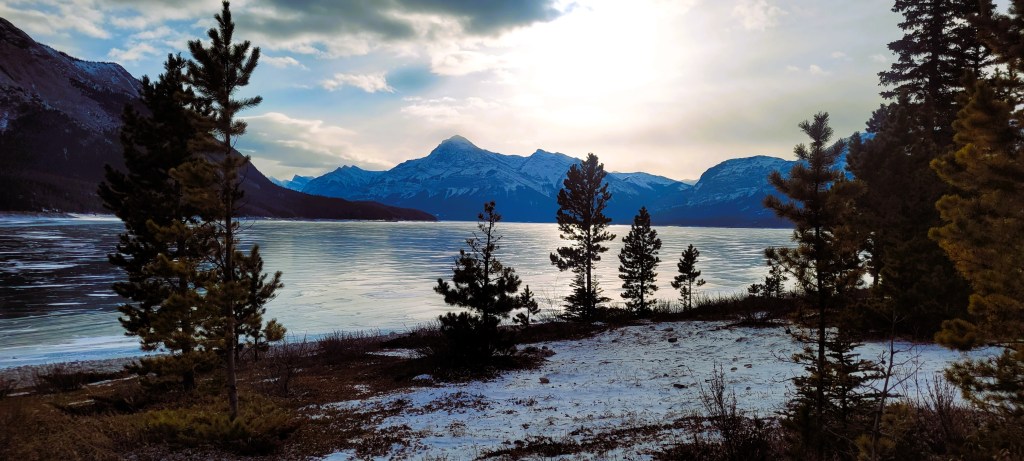
Abraham Lake, where sea fauna excrete methane caught in bubbles under clear ice. (Kat Dornian)
More often, now, there are moments so small, just a smile on my face and a breeze in the air. A moment of just hearing the gentle stream of water hit the sides of the tea kettle—listening for the boil. Smelling the aromas of cardamom and cloves and cinnamon lift in the air. All sounds, smells, and glittering light passing as soon as they appear. More often I need these fleeting moments. I need to focus on the next thing in front of me without becoming overwhelmed with the many paths one decision can take. I know this slowing down and focusing has been what I’ve needed, but the inability to hold the broader moment scares me and later fills me with the most regrets. But I never regret a moment of simply stopping to enjoy.
What I love about moments is the ambiguity of the amount of time they hold, like the length of a string or the air in a vessel. Moments, no matter how ephemeral or vast, seem best when perceived widely and openly.
Awoken
The time to sing dawns. Wren, robin, finch and jay rouse sleepy Helios with beaks and lyres blazing, plucking notes from dusky streams.
The dark is getting to me this year—persistent, cold, bitter. But, I’ll be damned if I let it stop me. One thing I know about the dark, is it must be faced. Not feared. Not ignored. Not fought. Not run from. And, for goodness sake, not given into.
That’s my weakness—giving in. I’m captivated by the dark. The stars, that milky stroke across the sky, the fleeting shadows, and the mystery draw me in. I could easily fall into the dark and let it consume me. Indeed, for much of the last four years I’ve had to hide in the dark to protect my skin, sanity, and immune system—staying away from sun and people.
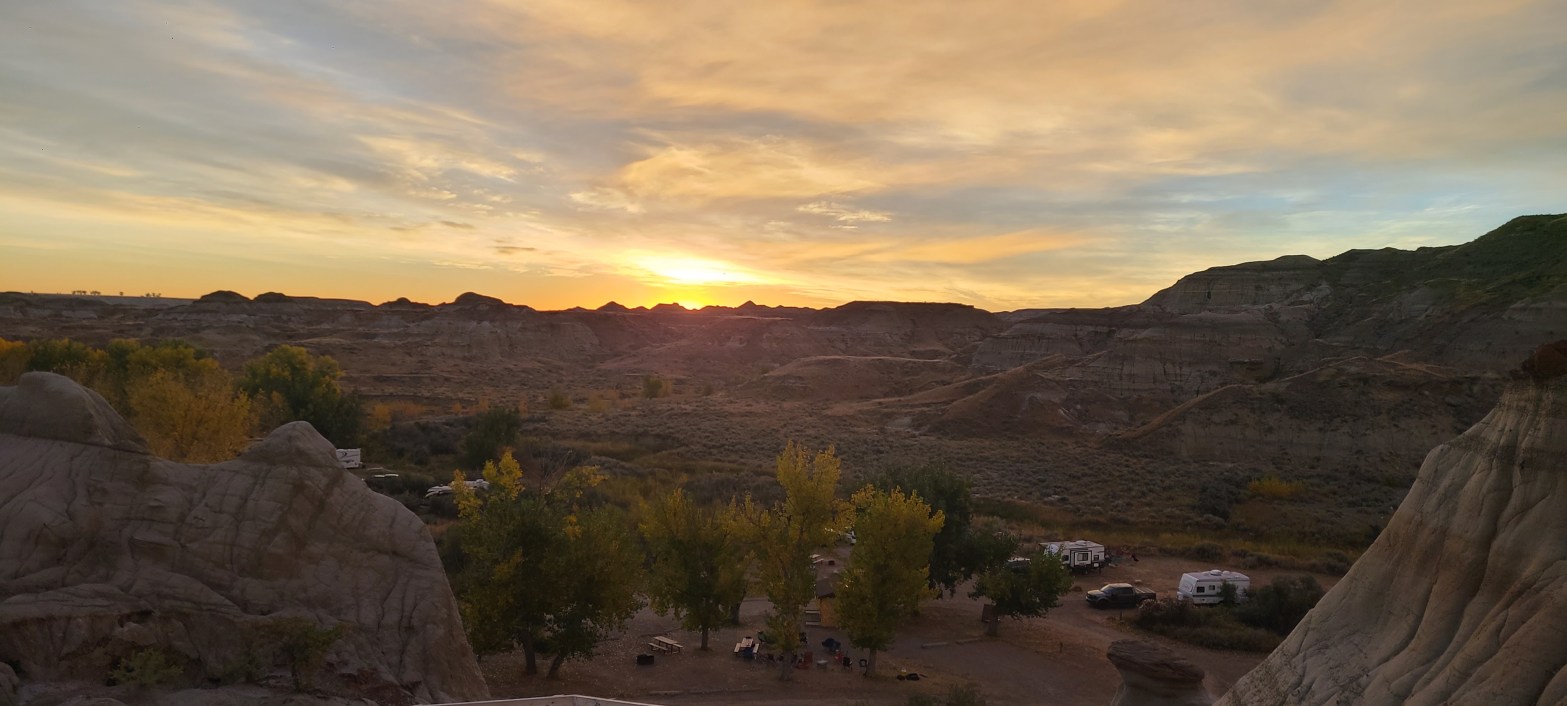
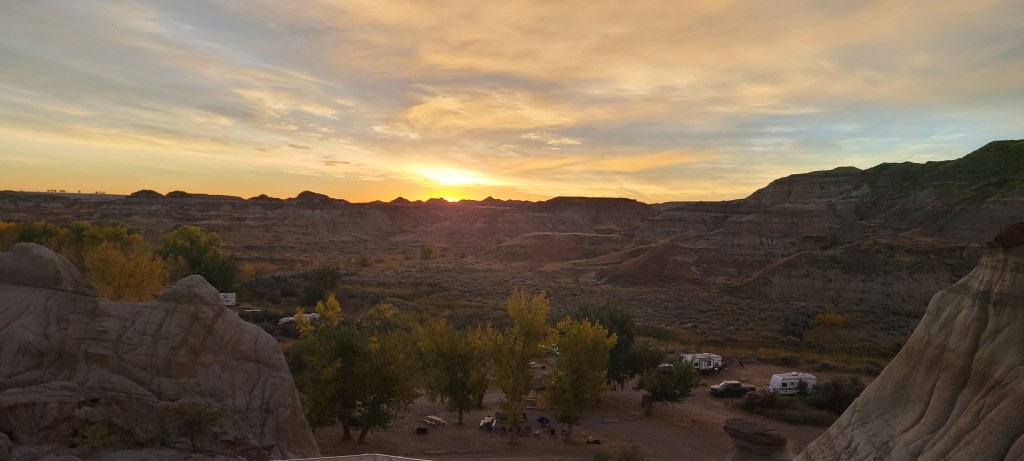
Rod and I went to Dinosaur Provincial Park in September.
A month ago, I sat in my doctor’s office and tears trickled down my cheeks, my breath caught in my throat, and sobs rang from my chest. I held my heart like a hug—a way to comfort myself. My onocologist handed me the tissue box. I’d just been told that the treatment I’m on usually extends survival by about 10 months. It’s a hard thing to hear. I’d just turned 39 and the laughter of my best friend’s first child still rang in my ears from the day before. There’s always light in the darkness, those stars that make the shadows flicker.
It’s not easy getting bad news as the nights grow longer and days become colder. There’s fewer activities to distract me and I’m forced to stay still, to nest… and ruminate. Furthermore, my new treatment makes me quite fatigued, which suits the 16 hour-long nights, but not keeping busy. Still, I get up the next day and make a grocery list because, goodness, I’ve dealt with everything else ad nauseam.
But this is what I’m talking about. I can give in too easy. I can plan so much for darkness that may never come (some darkness always does though). But my weakness is also my strength, because I can also plan for miserable things that need to be planned for. Not that I think death is miserable or dark, per se. But, to be honest, I still like life quite a lot and want to get the full experience—the good and bad, the sublime and imperfect, the light and dark—before I become dust and soil. And, so, I am looking at options. I may be going to the States next year for treatment, if I qualify. There’s a clinical trial coming to Calgary that may be a strong option for me.
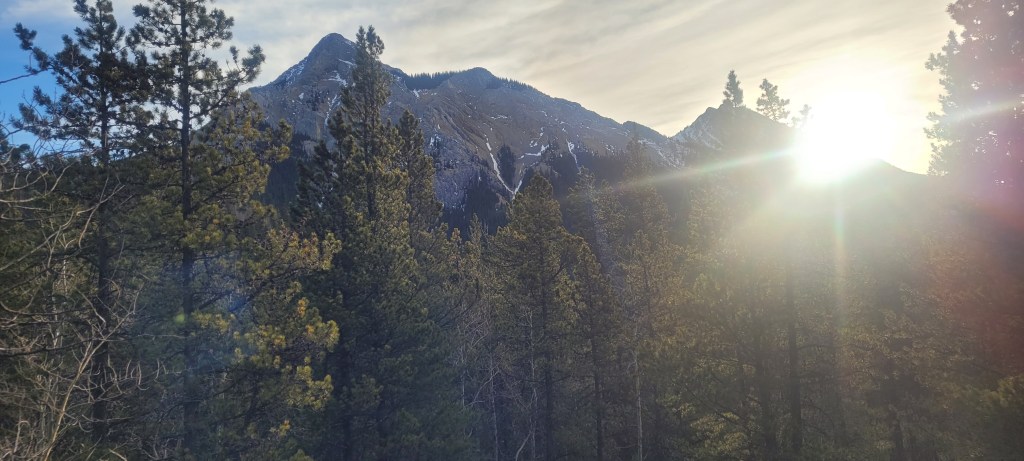
And so, I dwell in the darkness of the season, for a bit. I go for walks when the low-hanging sun hits my face. I let stars guide me to new horizons and opportunities, being ready for what may come.
It’s hard to believe I have cancer. Four years ago I had a port implanted in my chest and started chemotherapy. Four years later, I’m still here. I’m still on chemotherapy. It still feels surreal. Nonetheless, I am here.
I joked with my dermatologist that I’ve had cancer for as long as it takes to do an undergraduate degree. Although many of the feelings of grief, disbelief, wonder, and passion for living echo what I felt four years ago, there is also the journey I have been on and growth I have had in this time. Surprisingly, the hardest lessons have not been the innumerable drug names or what these drugs are doing or what all the different proteins and enzymes in my bloodwork are showing. The hardest lessons are what I’ve learned about cancer and the profound impacts of ableism on us—all of us. To this latter point, I’ll say that I still struggle with the ableist notions from which my understanding of the world grew, but I’m improving.
I’ve touched on my ableist belief system and my relationship with wellness culture before in my writing. Ableism is so ubiquitous and entrenched in society that it is a hard to shake. However, I’m becoming more adept at spotting ableist ideas and phrases now. This practice of spotting has allowed me to deepen my imagining of a world that’s possible if we treated disability differently.
I have much work to do toward this imagining. First, I must stop blaming myself for cancer. At least weekly, I see a post on social media or read an article or overhear a conversation where the individual with cancer is blamed for their cancer or rewarded for their remission: “if only they had been more healthy…”, “if only they had eaten better…”, “if only they had decided to do a complete 180 on their life to fight cancer…”. I understand how blame—or, to say it more gently, a cause and effect story—can give a sense of control and safety. And while I often think of myself as someone who is able to dwell in uncertainty, it is a draining practice. And so, I resort to ableism and the blaming of my imperfect body and my imperfect will: for skipping a workout, or eating a slice of cake, or staying out late for a few more songs to dance to.
I imagine, in a less ableist world, we see more grey areas—the magic in the liminal spaces—and are able to dwell in that uncertainty. We are not afraid of the vast differences in bodies and minds, allowing us to be gentler with “imperfections.” Perhaps we don’t use the words ‘perfection’ or ‘imperfection’ anymore. Perhaps, as our need for control gently dissolves, we see our connections to one another rather than the us-versus-them that’s awakened by fear and blame. Perhaps we feel our shared responsibility to care for our collective wellbeing. Cancer is not caused or reversed or worsened by the sole actions of an individual—it takes a community. It really does. And I am so thankful for mine.
For those who have stuck with me, thank you. Enough philosophizing; here’s an update of happenings since my last post to this site: I completed my creative writing certificate from the University of Calgary and am continuing to create and submit words. I pursued a liver transplant, but have decided that it is not right for me at this time. This is a tough decision to make; liver transplants do offer some patients many years of survival. However, recurrence rates are high (in my opinion), the surgery is risky, and I’d have more chronic health issues to manage for the rest of my life. I continued the chemotherapy treatment that caused skin irritation until June, at which point my health team and I decided it best to look at other treatments. Now, I am back on the chemotherapy regimen I had four years ago, with the hopes that it will be as effective as it was then and that the associated neuropathy holds off for a while. I also went to Iceland with my friend in March, which was an extraordinary adventure to an absolutely unique place. While travel was stressful for me, I somehow managed not to get sick and enjoy much of Icelandic culture and scenery.
I’m looking forward to the rest of 2025 and to being able to enjoy the outdoors a bit more now that my skin is not as sensitive to the sun. I’ll continue to write and learn (for another four years, at least, hopefully). And I’m continuing to look for emerging cancer treatments that might work for me; there are some promising therapies on the way to Canada, so stay tuned.
It’s hard to believe this is my life. It’s hard to accept my illness. But I’m getting better at that too!
Here’s a poem I wrote a year and a half ago. It feels time to release it from the annals of submission purgatory and share it with the world:
“Air” By Kat Dornian
August 24, 2023 Tunnel mountain, Banff National Park. Fog shrouds the river view as moss cascades off rocks. Pine and spruce creak in the gentle mountain breeze.
June 19, 2023 CT scan, enhanced, reveals three nodules in my right lung. The doctor says, ‘We all have nodules, it’s the pollution and the smoke.’
May 30, 2023 Camp Air-Eau-Bois, Lac Poisson Blanc. I breathe new air and dip my legs in the reservoir that’s drowning eighty-five square kilometers of Indigenous land.
May 15, 2023 Air quality index reaches eleven. Five hundred and thirty-two thousand hectares of Alberta land burned. We stay indoors and run air purifiers.
October 30, 2022 CT scan shows ‘pleural effusions… lungs otherwise appear clear.’ I’ve been in the hospital sixteen days and counting, breathing oxygen from tubes.
August 29, 2022 Uclulet, B.C. A two-day drive from home after summer fires subsided. I’m on my own, breathing the ocean that summons redwood and seaweed air.
It’s colorectal cancer awareness month. I haven’t “celebrated” this month in the past as I’ve been dealing with resentment and anger that held me back from believing anything could be done. But I’ve done a lot of work and feel ready to share my journey in hopes that it may help others.
My most significant barrier in this journey was getting the testing I needed. I want to encourage people, especially young people, to advocate for themselves when they have symptoms. Symptoms of colorectal cancer include unusual bowel habits, blood in stool, abdominal pain, fatigue, and unexplained weight loss (among others: https://cancer.ca/en/cancer-information/cancer-types/colorectal/signs-and-symptoms).
My first symptom was blood in my stool. I brought this concern to my family doctor who told me it was hemorrhoids without any assessment. Still concerned, I went to two walk-in clinics, but they said they were unable to order tests as I’d need follow-up that they couldn’t provide and repeated that it was probably just hemorrhoids anyway given my age and good health. I switched family doctors. My new doctor seemed unconcerned about my symptoms, repeating that I was young and healthy. In 2020, I had an episode of such painful abdominal cramps that I went to emergency. The doctor there told me it was menstrual cramps and menstrual bleeding; as a 34-year-old with ample experience of both, I knew this wasn’t the case, but because of Covid, I had no one with me to deny this, and I was in too much pain at the time to speak up. I followed up with my family doctor and was referred for a colonoscopy; I was put on the non-urgent list.
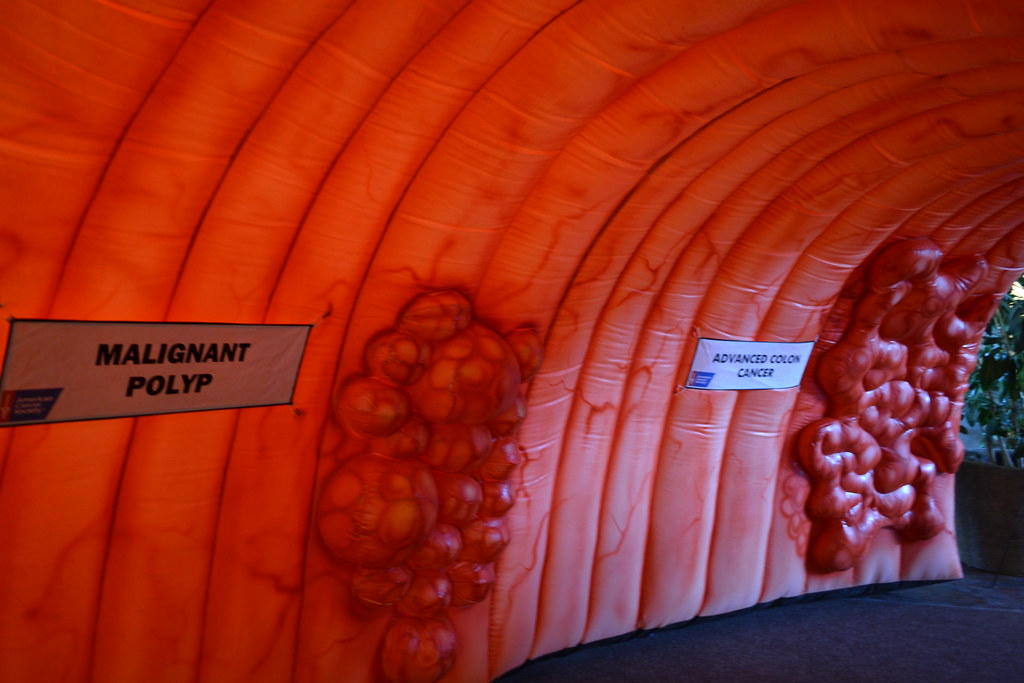
The epic inflatable colon courtesy A Healthier Michigan/flickr
What is described above, unfortunately, is all too common of a story for young people. By the summer of 2021, I felt sick constantly, had trouble eating, experienced poor bowel habits, and always felt exhausted. I went to the emergency again and was told I had to pick one thing that was bothering me, which at the time was my chest (it turned out the metastasis in my liver was pushing on my lungs and causing pain). The x-ray showed spots on my liver. They didn’t say cancer, but I knew this wasn’t good. My family doctor followed up the next day and changed my colonoscopy order to urgent. And that’s how this whole journey began.
I do not want other people to go through this. If I could make one suggestion that would have helped me, it would be to bring people with you to appointments! Tell your supporter what concerns you and ask for their help pushing back. I’ve been a very independent person for much of my life, but I found it difficult when I was in pain to speak up. Not only that, but it was hard for me to admit that something could be wrong despite knowing that early cancer detection leads to better outcomes.
One thing that constantly tripped me up was being “healthy.” I can’t count the number of times doctors would ask me, “Are you healthy?” What does that even mean? I’ve placed a high value on health since I was a teenager. Being a competitive swimmer, outdoorsy person, and diabetic made me learn how to take care of myself. Sure, I sometimes went too far, but I’ve always prided myself on healthy habits. It was this pride that ultimately made me believe doctors when they assured me that someone healthy like me wouldn’t have something like cancer! Since then, I’ve discovered lots of healthy people get cancer: marathon runners, weight lifters, and regular people with great routines. There are many pathways and variations to colon cancer and any cancer.
I have heard friends say that they don’t see a point in being healthy if someone like me could get cancer. Well, here’s the thing: I value having the healthy habits I had before cancer. It took me a long time (42 months at least) to overcome my resentment, but here I am. For one, my healthy habits brought me benefits as I practiced them (joy, self-discovery, better emotional regulation, great poops, better blood sugar management, etc). For two, it’s been easy for me to continue these habits through treatment, which has been helpful. And for three, I believe some of my recovery and stability can be attributed to these habits.
For me, healthy habits include
Maintaining a strong social network. I love my book clubs, writing groups, friend circles, and one-on-one hangs. This has become vital as I navigate cancer, yet the work I did throughout my 20s and the people who reciprocated have proven invaluable in my support network. As social media and smartphones make loneliness all the more pervasive, it is critical that we put in the effort to maintain in-person connections as much as we can.
Paying attention to stress. I started a serious meditation practice around 2017. It helped me move slower and be more aware of my feelings. At the same time, I started seeing a CBT psychologist who helped me look for stress warning signs and practice emotional regulation. I’m grateful to my mom, who modelled work-life balance. Although I’m a real go-getter, I have always tried to keep work to 8 hours a day. However, my enthusiasm for life and fear of boredom cause some overcommitment issues, which I’m working on.
Exercising! Exercise is one of my favourite things. I love how it makes me feel, positively affects my mood, and helps me control my blood sugar. I love going for morning jogs and discovering the places where I am (I have seen wildlife like armadillos, storks, deer, and so much more)! Morning jogs let me catch beautiful sunsets and capture the most serene moment of the day. Swimming allowed me time for quiet reflection and focus. I’ve been lucky to have wonderful ways to get to work that bring me through forests and along rivers, even if they take a bit longer.
Eating whole foods. I’ve always loved cooking from scratch. I love playing with flavours and how satisfying a home-cooked meal is. I used to indulge in much more cake and candy than I do now. And I feel a lot better cutting back on those things. My tummy is a lot happier, and my energy is even. I’m hopeful my high-probiotic, high-fibre diet pre-cancer—and a bit of luck—helped my colon get back on track after surgery! Butt [sic[, you got to love your microbiomes.
Taking care of my environment. Oddly, I never thought of this as a health measure. I care about the Earth, so I bought organic, local, and non-toxic products. Now that I have cancer, this comes up from time to time, and apparently what’s good for the Earth (low chemicals, low plastics, sustainable manufacturing practices) is also good for us! Go figure. It feels good to be doing something that helps the planet and us, and it’s nice that I don’t have to learn responsible purchasing habits from scratch.
Living meaningfully. One thing that lifted my spirits more than anything at the time I was diagnosed was having felt I lived a good life. I chose meaningful work, made choices based on my values, strove to minimize harm, and helped where I could. I embraced life and kept an open mind to experiences, leading to a sense of fullness. Living meaningfully has made the fear of death unthinkable for me. Ever since my dad died, I have always wanted to go to sleep knowing that if I should die tomorrow, I’d have lived well.
Sleeping has been the toughest thing for me. I’m still working on it, but I know it’s essential. I’ve always known sleep is important and aimed for the 7–8 hours a night, but I struggled in this hyper-lit and connected world. I have started dedicating more to a good sleep routine and love it. I feel like a regular routine and good sleep help me focus, but cancer treatment is also weird and zaps a lot of my energy. Still, I appreciate a good sleep routine.
Having financial stability. This one is tough because there are so many factors that affect my financial well-being, such as my family history and support (plus a pretty good settlement after a car hit me), which I do recognize not everyone has. Still, learning good financial practices early in life, like becoming confident in budgeting and investing, has served me well and has made me less stressed in this cancer journey.
I’m sorry to say that these habits won’t definitely prevent cancer. But, I do think they have helped me survive through cancer. I have resented this, and I have resented that I didn’t get to undergo some miraculous lifestyle change that somehow reversed my cancer; I don’t even know if I believe that is possible without modern medicine.
Nonetheless, the benefits of healthy living are vast, and I’d encourage everyone to try out one or two this year. And advocate for testing!!!
[All the ancient wisdom] tells us that work is necessary to us, as much a part of our condition as mortality; that good work is our salvation and our joy; that shoddy or dishonest or self-serving work is our curse and our doom.
― Wendell Berry, The Unsettling of America
By many accounts, I’ve had a productive year. I don’t know how to feel about this. Since my cancer diagnosis, I sought to find value in myself without the badge of outward accomplishments. At one point, my therapist told me, “You are a human being first, not a human doing.” Yet, I am writing a year-end wrap-up highlighting the launch of three projects in which I played significant roles. Not to mention, I had my first piece of creative writing published in Wishbone Words, Issue 14.
Spiritual thinkers like Wendell Berry and Thich Nhat Hanh offer wisdom to this question I pose to myself about productivity. Both saw value in good work. That’s the work I hope I did this year: Work that was honest, compassionate, and helped my community.
It feels strange to be busy while going to chemo every two weeks and managing the strain of type 1 diabetes while my endocrine system acts up—perhaps from steroids, perhaps from the strains of chemo. It is not easy, and it means having to be very intentional about my work. Like many disabled people, I find myself on the fringes of work—needing work that allows me the time I need for self-care and prioritizing my needs.
Unfortunately, I decided to depart from my pre-cancer career. I couldn’t do it when extreme medical side effects made it difficult to show up in an office and commit to five hours of solid work. I loved the routine and the connections with people that I gained by returning to work, and the project I was working on was interesting. However, I also realized how my priorities have changed in the past three years of treatment. Nonetheless, it was an honour to contribute to Quantum Sandbox 2.0.
From home, I helped with two community projects this year: The ElevateUP Career Mentorship Program with The Dollar Detectives and Imagine—Reshaping Adolescent and Young Adult Cancer Care Through Immersive Experience with Anew Research Collaborative. These projects were filled with incredible learning about community engagement and leadership. I feel honoured to have seen these projects flourish alongside the dozens of co-creators and collaborators.
In this community spirit, I recognize how different each of us is. How meaningful, honest, and compassionate work looks different for everyone. I saw how our ability to work—or not—does not diminish our basic humanity and right to live a joyful life, and how society’s view of productivity is not a measure of our worth. I am thankful to my friends who show up in many ways: compassionately, joyfully, and in service to their families and communities. It is so beautiful to watch the diversity of ways we do the good, necessary work—even and especially when it doesn’t fit society’s definition.
Thank you, my friends, new and old!
Do not live with a vocation that is harmful to humans and nature. Do not invest in companies that deprive others of their chance to live. Select a vocation that helps realize your ideal of compassion.
― Thich Nhat Hanh, The Fourteen Precepts of Engaged Buddhism
Quotes:
Berry, Wendell. The unsettling of America: Culture & agriculture. Catapult, 2015.
Hanh, Thich Nhat. “The Fourteen Precepts of Engaged Buddhism.” Social Policy 33, no. 1 (2002).
Another milestone approaches, one I’d never thought I’d reach: my fiftieth round of chemo. Honestly, I thought I’d have left cancer well behind me by this point. There’s a small chance I have; there’s many chances I haven’t. I’m choosing a practical optimism at every opportunity I get, but to be honest, it’s difficult to deal with the uncertainty of what this actually means.
The remaining three tumors in my liver (each the size of dice) appear to be largely calcified—like little skeletons buried in the vibrant ecosystem of my liver. I’m so grateful and awed by the ways the body strives to live. And, I’m grateful for medicine, and the ongoing development of new and better tests and therapies. The thought of going off of the treatment that has kept me alive for the last thirty-two months is frightening, while also relieving (two seemingly competing truths existing together). But even to be here is amazing. Even just fifteen years ago, I wouldn’t have had access to the same drugs I have today.
This got me thinking. I looked up causes of death through history. The first thing I saw was that only a century ago almost fifty percent of people died before they were adults. Nowadays, that number is below one percent. Frankly, I’d be dead if I was born a century earlier. I had pneumonia when I was around eight years old. It would have killed me a hundred years ago, and it could have killed me had I not been born in a wealthy country even now. Type 1 diabetes was a miserable death sentence a century ago. It’s frankly amazing that discoveries and innovations, combined with a handful of other close calls, have given me as much life as I have. And this is probably true for nearly half of the people reading this, half of your friends, half of your coworkers, half of the brilliant people making these discoveries.
I have a lot of gratitude these days. It keeps me uplifted and hopeful. It helps me see all beings as caring and giving of their best. It helps me see and feel my place in the web of being. Basically, it helps me just to see so much. I think about being a kid, and writing thank you cards to family members after Christmas gifts were exchanged. It was a simple practice of gratitude that informed my inclination to the practice later in life. And am I ever thankful for that too.
I remember (perhaps inaccurately, but to the best of my knowledge) being part of the health and safety committee at work, and as part of a mental health strategy, we implemented a thank you board in the office. It was largely a success, but concerns were raised that we shouldn’t be thanking people just for doing their jobs. I get where people are coming from with this argument, but I put forth that thanking someone is a rather simple action in comparison to the meaningful effect it can have. And who knows, some people struggle to get out of bed in the morning, how does some recognition change their morning? Others may feel like an imposter, or face any other struggles that plague us in the workplace, how does some appreciation change their work? I think about how differently I show up to conversations when someone simply shows appreciation for the effort I have put into a piece of work, even if my efforts turn out to be misinformed or otherwise shit.
In this spirit of appreciation, I’ll stop with the sappy, self-helpy vibes and say that the best thing these days is my hair. Although there is chemo-induced thinning, there is also chemo-induced curls. After getting over the initial confusion of coping with this newfound mess, I found a style that I adore. I honestly think that this is the first time in my life that I’m genuinely pleased with how my hair looks. It’s a funny fluff on the top of my head, which is perfect for my face shape, looks the perfect amount of androgynous, actually requires very minimal styling, and the curl shampoo and conditioner moisturizes my scalp so no more dry skin flakes! It’s a bit weird to be overjoyed with a hairstyle that was caused by cancer treatment, but there you have it. Thanks chemo!
Chemo curls always look cool
I’ll leave it there for now. I’ve been changing and learning (and being grateful for my consistently curious self) these last thirty-two months. Perhaps I’ll say more next time. Be well and be grateful!
I am from glass globes of roses, from Gardenias and Gerbers. I am from dust floating in the air, caught in winter sun. I am from lilacs that can’t be contained, whose fragrance colours early spring.
I’m from toilet paper tubes and marbles, from King’s Daughters and Mayflowers. I am from a pinch of salt, pull your weight and no one wants to hear you complain.
I am from rocky cathedrals, midnight masses and incense. From forbidden dances held long into the night under Aurora Borealis.
I am from moments folded into paper, hung down halls on sooty walls, lingering in stories, on pages, in ashes flickering away.
This poem follows George Ella Lyon’s I Am From form. She and Julie Landsman created the I Am From Project around 2018 to use the power of poetry to counteract the rise of xenophobia and division in the United States. Even though the project has concluded, use of the template is still a powerful tool for connection.
There’s various templates and writing prompts you can use to dive in if you want to give it a try. If you’ve written one of these poems, please share it with me in the comments!

 Kat Dornian