The dark is getting to me this year—persistent, cold, bitter. But, I’ll be damned if I let it stop me. One thing I know about the dark, is it must be faced. Not feared. Not ignored. Not fought. Not run from. And, for goodness sake, not given into.
That’s my weakness—giving in. I’m captivated by the dark. The stars, that milky stroke across the sky, the fleeting shadows, and the mystery draw me in. I could easily fall into the dark and let it consume me. Indeed, for much of the last four years I’ve had to hide in the dark to protect my skin, sanity, and immune system—staying away from sun and people.
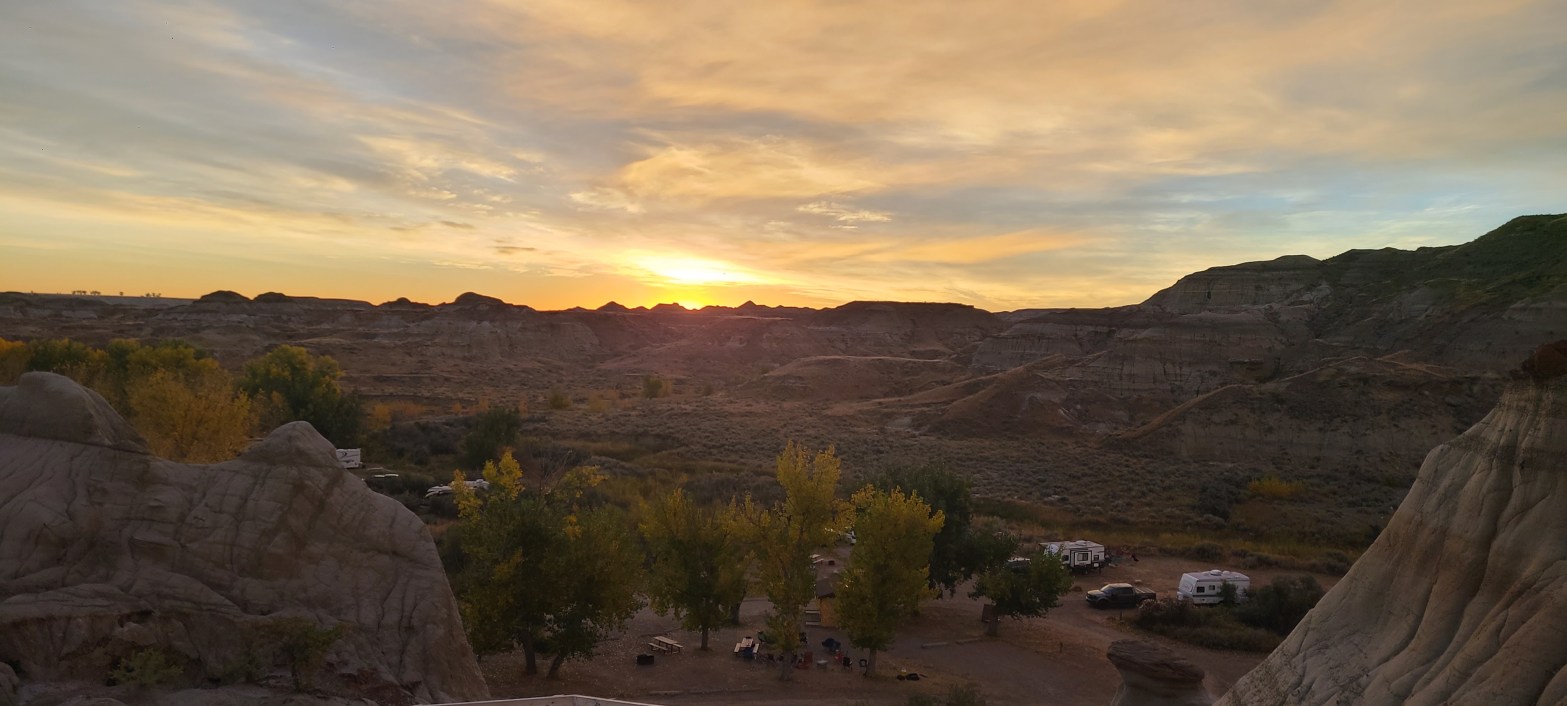
Rod and I went to Dinosaur Provincial Park in September.
A month ago, I sat in my doctor’s office and tears trickled down my cheeks, my breath caught in my throat, and sobs rang from my chest. I held my heart like a hug—a way to comfort myself. My onocologist handed me the tissue box. I’d just been told that the treatment I’m on usually extends survival by about 10 months. It’s a hard thing to hear. I’d just turned 39 and the laughter of my best friend’s first child still rang in my ears from the day before. There’s always light in the darkness, those stars that make the shadows flicker.
It’s not easy getting bad news as the nights grow longer and days become colder. There’s fewer activities to distract me and I’m forced to stay still, to nest… and ruminate. Furthermore, my new treatment makes me quite fatigued, which suits the 16 hour-long nights, but not keeping busy. Still, I get up the next day and make a grocery list because, goodness, I’ve dealt with everything else ad nauseam.
But this is what I’m talking about. I can give in too easy. I can plan so much for darkness that may never come (some darkness always does though). But my weakness is also my strength, because I can also plan for miserable things that need to be planned for. Not that I think death is miserable or dark, per se. But, to be honest, I still like life quite a lot and want to get the full experience—the good and bad, the sublime and imperfect, the light and dark—before I become dust and soil. And, so, I am looking at options. I may be going to the States next year for treatment, if I qualify. There’s a clinical trial coming to Calgary that may be a strong option for me.
And so, I dwell in the darkness of the season, for a bit. I go for walks when the low-hanging sun hits my face. I let stars guide me to new horizons and opportunities, being ready for what may come.
It’s hard to believe I have cancer. Four years ago I had a port implanted in my chest and started chemotherapy. Four years later, I’m still here. I’m still on chemotherapy. It still feels surreal. Nonetheless, I am here.
I joked with my dermatologist that I’ve had cancer for as long as it takes to do an undergraduate degree. Although many of the feelings of grief, disbelief, wonder, and passion for living echo what I felt four years ago, there is also the journey I have been on and growth I have had in this time. Surprisingly, the hardest lessons have not been the innumerable drug names or what these drugs are doing or what all the different proteins and enzymes in my bloodwork are showing. The hardest lessons are what I’ve learned about cancer and the profound impacts of ableism on us—all of us. To this latter point, I’ll say that I still struggle with the ableist notions from which my understanding of the world grew, but I’m improving.
I’ve touched on my ableist belief system and my relationship with wellness culture before in my writing. Ableism is so ubiquitous and entrenched in society that it is a hard to shake. However, I’m becoming more adept at spotting ableist ideas and phrases now. This practice of spotting has allowed me to deepen my imagining of a world that’s possible if we treated disability differently.
I have much work to do toward this imagining. First, I must stop blaming myself for cancer. At least weekly, I see a post on social media or read an article or overhear a conversation where the individual with cancer is blamed for their cancer or rewarded for their remission: “if only they had been more healthy…”, “if only they had eaten better…”, “if only they had decided to do a complete 180 on their life to fight cancer…”. I understand how blame—or, to say it more gently, a cause and effect story—can give a sense of control and safety. And while I often think of myself as someone who is able to dwell in uncertainty, it is a draining practice. And so, I resort to ableism and the blaming of my imperfect body and my imperfect will: for skipping a workout, or eating a slice of cake, or staying out late for a few more songs to dance to.
I imagine, in a less ableist world, we see more grey areas—the magic in the liminal spaces—and are able to dwell in that uncertainty. We are not afraid of the vast differences in bodies and minds, allowing us to be gentler with “imperfections.” Perhaps we don’t use the words ‘perfection’ or ‘imperfection’ anymore. Perhaps, as our need for control gently dissolves, we see our connections to one another rather than the us-versus-them that’s awakened by fear and blame. Perhaps we feel our shared responsibility to care for our collective wellbeing. Cancer is not caused or reversed or worsened by the sole actions of an individual—it takes a community. It really does. And I am so thankful for mine.
For those who have stuck with me, thank you. Enough philosophizing; here’s an update of happenings since my last post to this site: I completed my creative writing certificate from the University of Calgary and am continuing to create and submit words. I pursued a liver transplant, but have decided that it is not right for me at this time. This is a tough decision to make; liver transplants do offer some patients many years of survival. However, recurrence rates are high (in my opinion), the surgery is risky, and I’d have more chronic health issues to manage for the rest of my life. I continued the chemotherapy treatment that caused skin irritation until June, at which point my health team and I decided it best to look at other treatments. Now, I am back on the chemotherapy regimen I had four years ago, with the hopes that it will be as effective as it was then and that the associated neuropathy holds off for a while. I also went to Iceland with my friend in March, which was an extraordinary adventure to an absolutely unique place. While travel was stressful for me, I somehow managed not to get sick and enjoy much of Icelandic culture and scenery.
I’m looking forward to the rest of 2025 and to being able to enjoy the outdoors a bit more now that my skin is not as sensitive to the sun. I’ll continue to write and learn (for another four years, at least, hopefully). And I’m continuing to look for emerging cancer treatments that might work for me; there are some promising therapies on the way to Canada, so stay tuned.
It’s hard to believe this is my life. It’s hard to accept my illness. But I’m getting better at that too!
[All the ancient wisdom] tells us that work is necessary to us, as much a part of our condition as mortality; that good work is our salvation and our joy; that shoddy or dishonest or self-serving work is our curse and our doom.
― Wendell Berry, The Unsettling of America
By many accounts, I’ve had a productive year. I don’t know how to feel about this. Since my cancer diagnosis, I sought to find value in myself without the badge of outward accomplishments. At one point, my therapist told me, “You are a human being first, not a human doing.” Yet, I am writing a year-end wrap-up highlighting the launch of three projects in which I played significant roles. Not to mention, I had my first piece of creative writing published in Wishbone Words, Issue 14.
Spiritual thinkers like Wendell Berry and Thich Nhat Hanh offer wisdom to this question I pose to myself about productivity. Both saw value in good work. That’s the work I hope I did this year: Work that was honest, compassionate, and helped my community.
It feels strange to be busy while going to chemo every two weeks and managing the strain of type 1 diabetes while my endocrine system acts up—perhaps from steroids, perhaps from the strains of chemo. It is not easy, and it means having to be very intentional about my work. Like many disabled people, I find myself on the fringes of work—needing work that allows me the time I need for self-care and prioritizing my needs.
Unfortunately, I decided to depart from my pre-cancer career. I couldn’t do it when extreme medical side effects made it difficult to show up in an office and commit to five hours of solid work. I loved the routine and the connections with people that I gained by returning to work, and the project I was working on was interesting. However, I also realized how my priorities have changed in the past three years of treatment. Nonetheless, it was an honour to contribute to Quantum Sandbox 2.0.
From home, I helped with two community projects this year: The ElevateUP Career Mentorship Program with The Dollar Detectives and Imagine—Reshaping Adolescent and Young Adult Cancer Care Through Immersive Experience with Anew Research Collaborative. These projects were filled with incredible learning about community engagement and leadership. I feel honoured to have seen these projects flourish alongside the dozens of co-creators and collaborators.
In this community spirit, I recognize how different each of us is. How meaningful, honest, and compassionate work looks different for everyone. I saw how our ability to work—or not—does not diminish our basic humanity and right to live a joyful life, and how society’s view of productivity is not a measure of our worth. I am thankful to my friends who show up in many ways: compassionately, joyfully, and in service to their families and communities. It is so beautiful to watch the diversity of ways we do the good, necessary work—even and especially when it doesn’t fit society’s definition.
Thank you, my friends, new and old!
Do not live with a vocation that is harmful to humans and nature. Do not invest in companies that deprive others of their chance to live. Select a vocation that helps realize your ideal of compassion.
― Thich Nhat Hanh, The Fourteen Precepts of Engaged Buddhism
Quotes:
Berry, Wendell. The unsettling of America: Culture & agriculture. Catapult, 2015.
Hanh, Thich Nhat. “The Fourteen Precepts of Engaged Buddhism.” Social Policy 33, no. 1 (2002).
Another milestone approaches, one I’d never thought I’d reach: my fiftieth round of chemo. Honestly, I thought I’d have left cancer well behind me by this point. There’s a small chance I have; there’s many chances I haven’t. I’m choosing a practical optimism at every opportunity I get, but to be honest, it’s difficult to deal with the uncertainty of what this actually means.
The remaining three tumors in my liver (each the size of dice) appear to be largely calcified—like little skeletons buried in the vibrant ecosystem of my liver. I’m so grateful and awed by the ways the body strives to live. And, I’m grateful for medicine, and the ongoing development of new and better tests and therapies. The thought of going off of the treatment that has kept me alive for the last thirty-two months is frightening, while also relieving (two seemingly competing truths existing together). But even to be here is amazing. Even just fifteen years ago, I wouldn’t have had access to the same drugs I have today.
This got me thinking. I looked up causes of death through history. The first thing I saw was that only a century ago almost fifty percent of people died before they were adults. Nowadays, that number is below one percent. Frankly, I’d be dead if I was born a century earlier. I had pneumonia when I was around eight years old. It would have killed me a hundred years ago, and it could have killed me had I not been born in a wealthy country even now. Type 1 diabetes was a miserable death sentence a century ago. It’s frankly amazing that discoveries and innovations, combined with a handful of other close calls, have given me as much life as I have. And this is probably true for nearly half of the people reading this, half of your friends, half of your coworkers, half of the brilliant people making these discoveries.
I have a lot of gratitude these days. It keeps me uplifted and hopeful. It helps me see all beings as caring and giving of their best. It helps me see and feel my place in the web of being. Basically, it helps me just to see so much. I think about being a kid, and writing thank you cards to family members after Christmas gifts were exchanged. It was a simple practice of gratitude that informed my inclination to the practice later in life. And am I ever thankful for that too.
I remember (perhaps inaccurately, but to the best of my knowledge) being part of the health and safety committee at work, and as part of a mental health strategy, we implemented a thank you board in the office. It was largely a success, but concerns were raised that we shouldn’t be thanking people just for doing their jobs. I get where people are coming from with this argument, but I put forth that thanking someone is a rather simple action in comparison to the meaningful effect it can have. And who knows, some people struggle to get out of bed in the morning, how does some recognition change their morning? Others may feel like an imposter, or face any other struggles that plague us in the workplace, how does some appreciation change their work? I think about how differently I show up to conversations when someone simply shows appreciation for the effort I have put into a piece of work, even if my efforts turn out to be misinformed or otherwise shit.
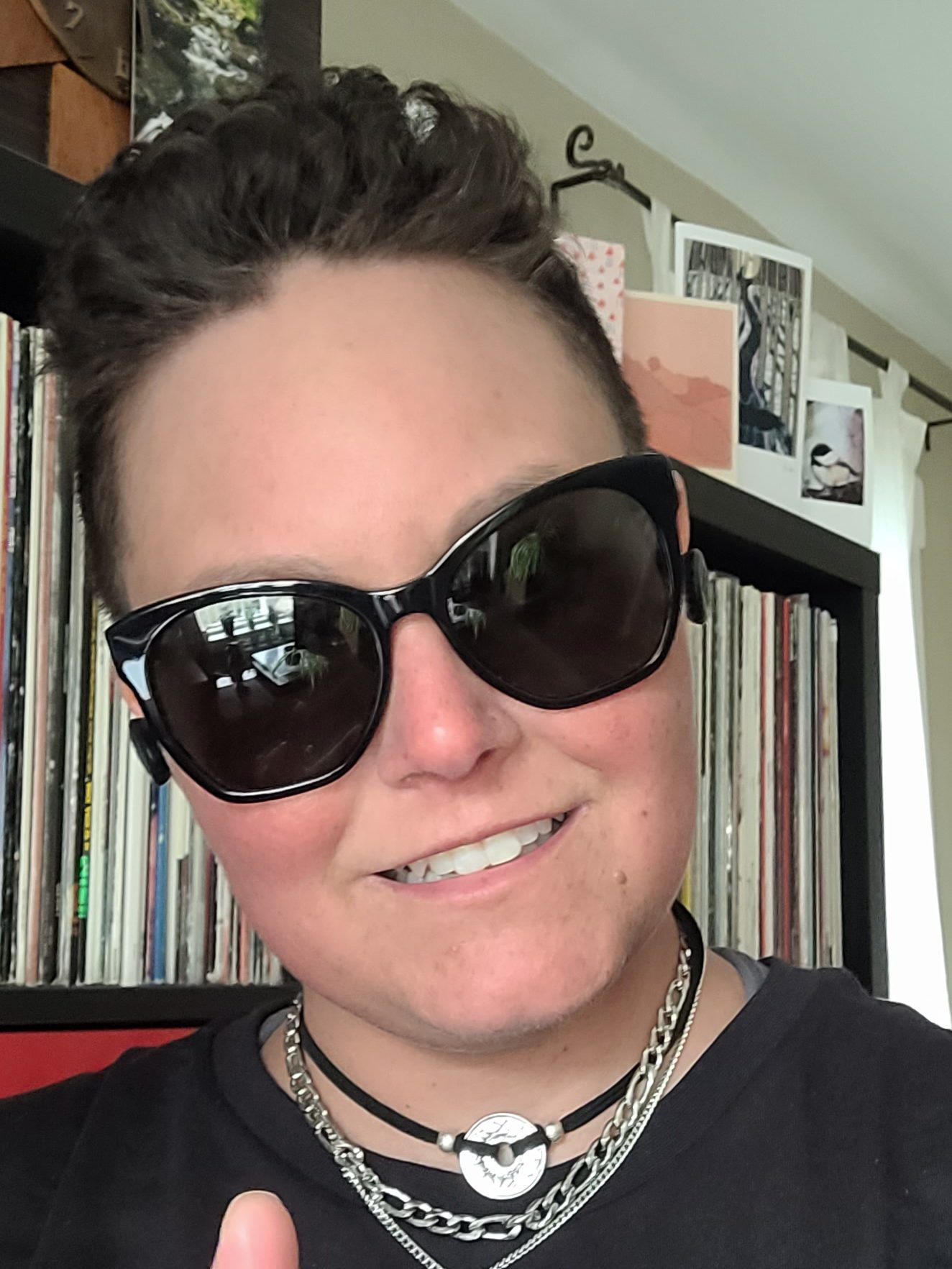
In this spirit of appreciation, I’ll stop with the sappy, self-helpy vibes and say that the best thing these days is my hair. Although there is chemo-induced thinning, there is also chemo-induced curls. After getting over the initial confusion of coping with this newfound mess, I found a style that I adore. I honestly think that this is the first time in my life that I’m genuinely pleased with how my hair looks. It’s a funny fluff on the top of my head, which is perfect for my face shape, looks the perfect amount of androgynous, actually requires very minimal styling, and the curl shampoo and conditioner moisturizes my scalp so no more dry skin flakes! It’s a bit weird to be overjoyed with a hairstyle that was caused by cancer treatment, but there you have it. Thanks chemo!
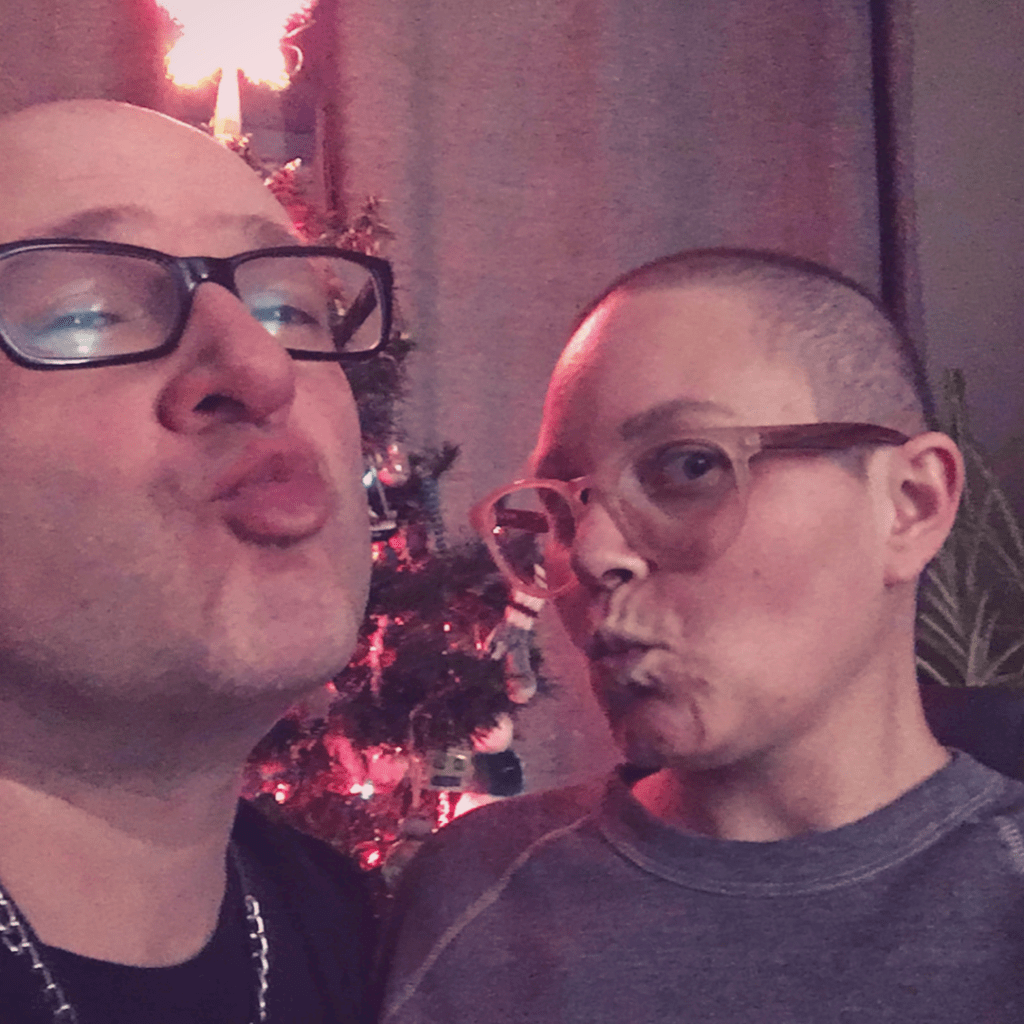
Chemo curls always look cool
I’ll leave it there for now. I’ve been changing and learning (and being grateful for my consistently curious self) these last thirty-two months. Perhaps I’ll say more next time. Be well and be grateful!
December had been coming to a close with a glow of optimism. In the final weeks of 2024, I had a CT and MRI scan. I expected good results, given that September’s tests showed an excellent response to the new drugs I was on. My continued skin problems should have been a sign that the drugs were working on my tumours as much as they were irritating my skin. As you might detect in my wording here, the scans were not great, but not terrible. Heck, maybe they’re better than I’m giving them credit for. The lesions in my liver remain the same size as they were in September, which means I probably won’t qualify for surgery and that I may need to move onto another treatment path (or not) yet again. This isn’t uncommon, but it still sucks. In particular, the ongoing uncertainty sucks.
With this news, the new year didn’t have the “turning a new page” glow that I often experience around this time.
After ringing in two new years while on chemo and having been in treatment for so long, the fascination with it all–which gave some excitement to the otherwise horrendous experience–has largely faded into the dull hum of life. (This is part of the reason I don’t post as much anymore). I’ve gotten so much bloodwork and so many scans that they all feel mundane. One pathetic highlight of the last year was finding free parking near the hospital, which also provides a rather scenic and peaceful walk before appointments.
It feels like I’ll be on this journey forever, and I don’t know what that means or looks like.
Although uncertainty about the future is a fact of all our lives, going into 2024 feels like a particularly unwelcome point of uncertainty for me. I still look forward to the fruition of some projects, but I worry about my ability to be fully present. I expect myself to be the person I was before diagnosis, which just isn’t the case anymore. I have chosen projects that give me the flexibility and accommodations I need. Still, I remember when prioritizing flexible work hours and modes of work was less important. Navigating my abilities and limitations makes everything more complicated.
I try to find grounding, joy, and hope, but sometimes the ominous grey clouds do not clear as readily.
I am frustrated by the slow pace at which I operate. For one, treatments put me out for a few days, followed by a few more slow days as I recover my energy. I have so many healthcare appointments to manage. My mental ability is hit or miss; I find myself forgetting a lot more and finding it hard to focus for extended periods of time. I lose words. I become overwhelmed with how best to take care of myself. I worry about people noticing my difficulty forming and expressing coherent thoughts.
I’m practicing several ways to cope, and I am grateful for a younger version of myself who developed many healthy strategies.
Of all the healthy routines I’ve practiced, I’ve always struggled with enjoying the present moment. A moment can be a fraction of a second or extend over millennia. The past and future press into even the most minuscule moment, shaping it. I can’t divorce the history of my body and surroundings from the millisecond I reside in, the present. Likewise, although in a more obscured way, I am aware of the buzzing of the future that my body enters and builds from this moment. For these reasons, I struggle to find presence.
Is the present a tiny speck in the universe of time? By the time I register what my senses perceive, the present is past, and I am catapulted against the portal to the future.
I am working on being present. That’s the most sure thing I can lay down for 2024. I don’t know where my health journey will take me, but the projects I’m working on are full of possibilities, and I look forward to them taking their shape. For me, I’ll be sitting in the present each day and trying to sense its fullness. Maybe this year, I’ll find it.
I don’t want to talk about cancer all the time, yet it pervades so much of what I share here. I expect the new year to bring a shift into more expansive writing. Here’s why:
At this time last year, I was settling into the cycles of chemo. The grief of diagnosis gave way to an urge to reconnect with myself and my community. Although treatment and my body’s healing still demanded much of my time throughout the year, I gradually sunk into connecting with my passions and giving what I had to offer. Over time, I spent more energy being me than worrying about cancer.
“No Self stands alone. Behind it stretches an immense chain of physical and—as a special class within the whole—mental events, to which it belongs as a reacting member and which it carries on.”
Erwin Schrödinger, My View of the World
I have found throughout the last year that cancer has undeniably shaped me and yet not become the sole definition of who I am, as I once feared it would. I don’t push away or deny cancer as part of my identity. I like to think I’ve been learning how to let cancer identity take the space it needs, no more and no less. In doing so, I’ve also found the parts of me that shine—an outdoor enthusiast, an active person, an art lover, an educator, and a designer. Oddly, as I’ve seen these parts, I’ve been drawn to the simple question of “who am I,” exactly? Like the Earth shifting from season to season, the “I” is so constantly in motion with the world around it that the question is not so simple.
As I tried to answer this question and connect with the threads woven throughout my life, I observed how the cancer thread integrates with them. I wish these threads wove into a tight braid because that would be an easy and narratively clean answer to that “who am I” question. In reality, these threads loosen into a fabric lovingly woven with odds, ends, and beginnings—an “I” entwined with a messy whole. First, I find I cannot be defined by cancer alone, nor by any single part. So, while cancer happened to me and the self which sits here today has undoubtedly been shaped by the experience, I am still me. Second, there is no single identity in cancer. For each person, cancer’s impact takes a different shape. I notice that while I have the same experiences as others in the community, there is much I don’t relate to also. I am still that piece of fabric so different than the others and still sharing threads. Instead of denying this new part of my identity, I allowed it in, which has led to healing and for myself to come forth. In this healing, I have affirmed that I love being outdoors, moving, preparing food to share, learning, and helping others to learn by designing experiences. These activities have happily appeared throughout my life and have made me feel settled in who I am.
“There is no single entity whose identity is changeless. All things are constantly changing. Nothing endures forever or contains a changeless element called a ‘self.'”
Thich Nhat Hanh, Thundering Silence: Sutra on Knowing the Better Way to Catch a Snake
As I’ve dove more into systems practice, the most astounding realization of the year has surfaced. Since I was a teenager, a piece of advice has clung to me: If you want to change the world, you must first change yourself. Before 2022, I interpreted this to mean that one needed to be perfect before entering into service work for others. If you know me, you know I didn’t take this entirely literally, but it still nagged at me and led me toward constant self-improvement. It’s only been over the last few seasons that I’ve understood how simply changing oneself changes the larger whole one is part of. As the fabric of the self changes, it pulls on the threads of the entire universe. Likewise, as the cancer experience integrates, it shifts the other parts of me and all to which I am connected.
So, I see how I have been shaped by every experience that has brought my consciousness here, and no one else shares that. This experience—reaching back to eternity—makes a self so incredibly unique and at once impossible without the whole. As I shift like the seasons, I change my future and all I am connected to. It sounds grandiose, but with the perspective of my size in the immensity of time and space, it also seems remarkably insignificant.
All this reflection and what I want to say is I’ll write more over the coming year as I continue to explore. I’m unsure if I’ll share it on this blog, but if I do and you follow me, you will likely find more stories and thoughts without cancer as a feature.
For now, know that I am recovering well from surgery (a colon and liver resection). My bowels have pulled through for me and are 95% up to pre-surgery function—amazing. I have a big scar running through my abdomen, and I am excited for summer weather to show it off. I’ll hopefully have another surgery in the next few months for the rest of my liver. If all goes well, I’ll be able to ease back into doing those things I love more full-time and reliably.
Puberty hit me differently than most. I spent the prime summers of my teenage years in the woods. The days were filled with forest games, forging trails, and mud baths. The nights were spent around campfires or sprawled on smooth rocks next to the gentle woosh of the river. I fell in love with nature during these summers. It wasn’t the Taylors or Alexes that I wanted; I longed to connect with the Engelmann spruces and Douglas firs.
Ironically, my love of nature did not drive me toward a career in ecology. Quite the opposite; In the months beyond summer, I would create computer games, design websites, and fiddle with breadboards in my spare time. And that was the passion I followed as I matured.
Nonetheless, I could not sever my bond with Earth. I didn’t have words for it at the time, but I understand this love as biophilia now. The term put forth by Edward O. Wilson is defined as the human’s affinity for other life and the natural world.
When I received my diagnosis, my first instinct was to bathe in wild lakes and forests. I felt the powerful force of life surge through me, the force written into the DNA of every organism that lived to bring me here today. Starting with the single-cell lifeforms that divided billions and billions of years ago to these beautifully complex ecosystems that continue to find creative ways to sustain and persevere another tomorrow. Throughout my treatment, I’ve prioritized time with these incredible systems. I’ve rekindled my love with the natural world into a bright and steady glow.
Alas, with love comes pain. I once heard it said that to give oneself to love is to accept the eventual pain when the day comes for one to leave and one to be left behind—what some take as a worthy price for the most euphoric of human emotions. And so, extraordinary measures are taken to extend and protect life, the seemingly most innate instinct in our being.
In the month I got my diagnosis, the Intergovernmental Panel on Climate Change (IPCC) began issuing its sixth assessment on the science around climate change, its impact on our world, and what we can do about it. Here I was in August 2021: dealing with my own personal health crisis as news poured in about the escalating health crisis of this planet I deeply love.
Since then, I’ve undergone the medical treatments to shrink and eradicate my tumours (I’m still going). Like many interventions, the medicines come with a price: loss of sensation in fingers and toes, fatigue, and lowered immunity. So too, may we need to accept some losses in mitigating the most severe consequences of climate change, or else there may be much more to lose. But technical solutions are not the sole course of action available, so I’ve learned.
There are so much more than technical interventions in healing. I’ve seen presence, engagement, community, meaning-making, and hope work as some of those interventions. They’ve helped me through this time and could serve in confronting even global crises.
“So let’s resolve ourselves to live meaningfully, honestly acknowledging the truth that life is fragile, time is fleeting, and death is certain—and rather than ignore, avoid, or deny these realities, may we engage this time with greater clarity for our values, a deeper sense of gratitude and appreciation for what we do have, in richer authenticity to ourselves and others, so that we might invest in those relationships we deeply cherish and seek to make the world a better place.”
Daryl R. Van Tongeren
Presence and Engagement
“We must reinvent a future free of blinders so that we can choose from real options.”
David Suzuki
There is no use turning away from reality and pushing away discomfort. It seems fine at first, but it is much more painful in the long term. It’s said avoidance “dilutes our lives by robbing us of the urgency of a finite existence.” (Daryl R. Von Tongeren, Ph.D). Furthermore, Buddhist teacher Frank Ostaseski teaches that “Suffering is exacerbated by avoidance. … Our attempts at self-protection cause us to live in a small, dark, cramped corner of our lives.”
Presence is the practice of being in the moment and appreciating the little things. This practice fills life with meaning, purpose, and wholeness. That meaning is so vital in the difficult times. As psychologists JoshuaHicks and FrankMartela have proposed, “We should slow down, let life surprise us and embrace the significance in the everyday.”
From my own experience of practicing mindfulness, I can attest to and offer a different advantage. As I look back over my life, it is filled with these savoured moments and feelings: warm winds on my face during morning rides, rich risotto in a dim and lively restaurant, raucous laughter around a board game table. These gentle memories remind me of the meaning of my life while also giving me comfort that I’ve lived life well.
Engagement starts with presence. It is standing with our problems and reactions. It’s what allows us to choose meaningfulness day by day. Researchers have seen that this focus can allow negative emotions to coexist with action, instead of letting the emotions paralyze us. To do this, psychologist Susan David offers a reminder that “Emotions are data, they are not directives.” And feelings can be explored by investigating the function they might serve, allowing the emotion to be worked with and through. So too, looking deeper into problems we face, even globally, can give more hope and meaning to our lives.
While presence and engagement are excellent first steps, there’s deeper work needed for our planetary healing.
Community
“There’s never a clear point at which a being begins or ends, and that’s why we are all lichens: a being made up of multiple separate symbiotic organisms.”
Donna Haraway
There is a robust community among cancer patients if one should choose to pursue it. I’ve found great solace and connection with these friends. I’ve also been blessed to be in caring communities in my life beyond cancer. The power of community is incredible when others are there to lift and support the glow of each other. It breaks the walls of loneliness, makes connections, and moves us forward together. There’s hope, support, and meaning in the community… if done well.
Paul Born, founder of the Tamarack Institute, offers that we cannot settle for shallow communities or fear-based communities. These are rooted in turning away or against others. We must strive for deep community. Community, where stories unite us, time together is enjoyed, care is taken, and a better world emerges from our work. It is not passive work; it requires diligence and care, but the rewards are vast: connection, joy, and emergent good.
A “raft” of ants can cross a body of water that would be an insurmountable obstacle for one individual. Credit: Tim J. Patterson via Wikimedia CC BY-SA-3.0
Sarah Jaquette Ray, whose interdisciplinary pursuits have made her an expert on coping with climate anxiety, speaks to the importance of community in movements. In a recent LATimes article, she recommends, “We need to start where we are, use the talents we already have, and plug into groups and communities that are already doing the work. Building community around action should be our measure of success, and it can happen right now.”
Building a community cannot wait until the crisis is at the doorstep. Anyone can start today by working with organizations moving action forward and even by just reaching out to our neighbours. It can begin as simply as sharing ourselves, sharing a story.
Meaning-making
“The more one forgets himself—by giving himself to a cause to serve or another person to love—the more human he is and the more he actualizes himself.”
Viktor Frankl
Meaning-making weaves tightly with presence and engagement. Meaning builds as we appreciate the small things and know how our actions serve greater problems. In challenges as enormous as climate change, it is often more meaningful to focus on what choices and leverage points we do have control of.
Crisis and grief, such as comes with the threat of cancer or planetary extinction, can lead people to find more meaning in life. Grief leads to meaningful shifts in behaviour, such as spending more time with family, being more charitable, volunteering, or deepening spiritual practices. Furthermore, this meaning can surface through community or counselling work with methods such as storytelling (storytelling to cope with grief around climate crisis is abundant).
In his highly popular book, Man’s Search for Meaning, Austrian psychiatrist and Holocaust survivor Viktor Frankl reminds us of the importance of engagement in finding meaning: “What man actually needs is not a tensionless state but rather the striving and struggling for a worthwhile goal, a freely chosen task. What he needs is not the discharge of tension at any cost but the call of a potential meaning waiting to be fulfilled by him.” Luckily, Frankl reassures us that simply our actions and responsibleness towards our everyday choices give life that meaning.
Perhaps that worthwhile goal is a liveable planet. Those actions and choices can be as simple as choosing sustainable transport, buying local and buying less, talking to loved ones, and pushing decision makers toward sustainable choices, away from fossil fuels. Add to that the power of community action; Hope for a better world is palpable.
Practicing Hope
“Hope is a verb with its sleeves rolled up.”
David Orr
Ameme circulates from time to time, saying “When people think about travelling to the past, they worry about accidentally changing the present, but no one in the present really thinks they can radically change the future.” The intervention to this, I believe, is hope.
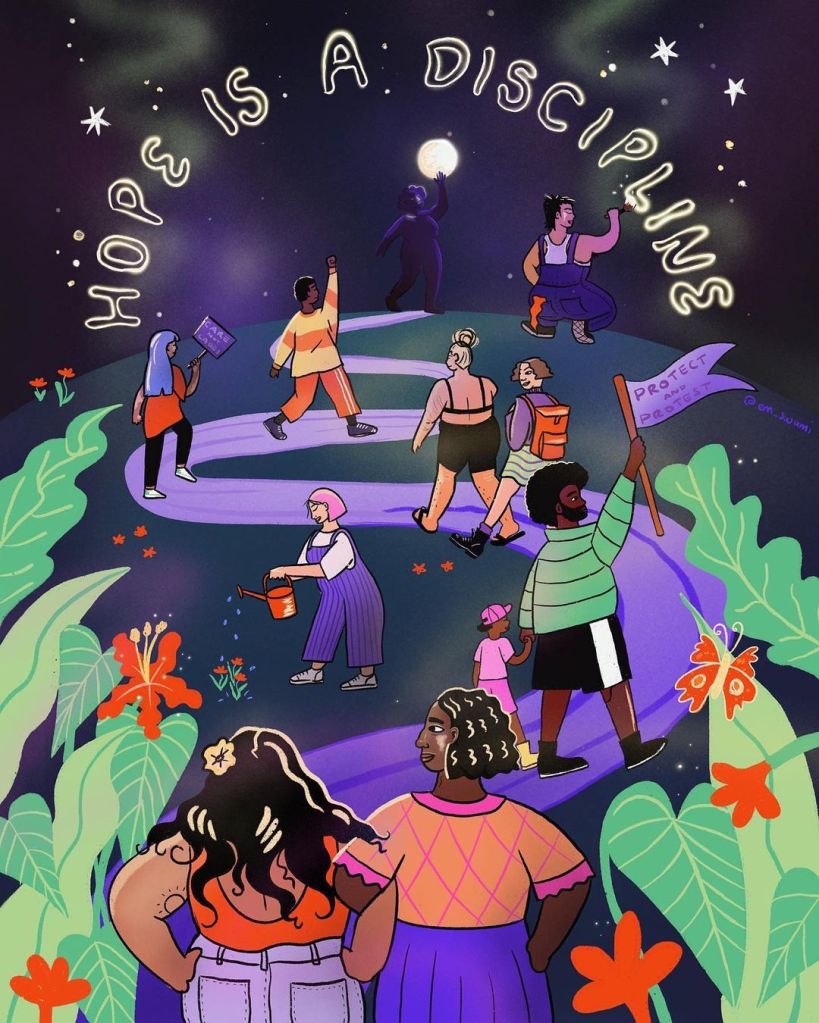
“Hope is a Discipline” – Mariame Kaba. Credit: @em_swami
For some, hope can feel defeating. But the future exists in the practice of hope. We can begin—today—to live stories of hope; Plantingmetaphoricalseeds for the future we want to see written. But to plant those seeds, we need the hope that they will grow, or else what’s the point?
Whether in the world of cancer or climate emergency, we can practice hope by engaging, choosing our actions with purpose, and becoming active in communities. We can have personal daily practices of mindfulness, presence, storytelling, and joyful connection. We can allow ourselves to fall in love, even though it may be painful. We can fall in love with every precious moment we get to spend among the trees.
Collected Resources
Creating deep community and why that matters: Born, Paul. Deepening community: Finding joy together in chaotic times. Berrett-Koehler Publishers, 2014.
How does meaning emerge from grief and crisis: Brody, Jane E., “Making Meaning Out of Grief.” New York Times, 2019. Lee, Virginia, et al. “Meaning-making and psychological adjustment to cancer: development of an intervention and pilot results.” Oncology nursing forum. Vol. 33. No. 2. Oncology Nursing Society, 2006.
A psychosocial healing strategy offered to cancer patients: Cunningham, Alastair J. Healing Journey. Key Porter Books, 1994.
The importance of meaning in adverse situations (and life in general): Frankl, Viktor E. Man’s search for meaning. Simon and Schuster, 1985.
For more on biophilia, look at the work of Edward O. Wilson: Kellert, Stephen R., and Edward O. Wilson, eds. The Biophilia Hypothesis. Island press, 1993.
How appreciating the little things can add depth and meaning to life: Hicks, Joshua, and Martela, Frank. “A New Dimension to a Meaningful Life.” Scientific American, 2022.
Speaking about different points at which we affect a system and make change: Meadows, Donella H. “Leverage points: Places to intervene in a system.” (1999): 980989.
For lessons about turning toward suffering, welcoming everything, and showing up whole (as well as more on living fully): Ostaseski, Frank. Five Invitations: Discovering What Death Can Teach Us About Living Fully. Pan Macmillan, 2017.
To read more about how problem- and meaning-focused teaching helps youth (and us) deal with climate change: Ratinen, Ilkka. “Students’ Knowledge of Climate Change, Mitigation and Adaptation in the Context of Constructive Hope.” Education Sciences 11.3 (2021): 103.
About dealing with climate anxiety through communities of action: Ray, Sarah Jacquette. “Op-Ed: Is Climate Anxiety Bad For the Planet.” Los Angeles Times, 2021. Ray, Sarah Jaquette. “A Field Guide to Climate Anxiety.” A Field Guide to Climate Anxiety. University of California Press, 2020.
Different ways to look at and practice hope: Tippet, Krista (host). “Future of Hope.” On Being, 2021.
There hasn’t been much change to my routine in the last few weeks. Not much news either, as I find myself in a sort of holding pattern. I am finding it difficult to write about myself amidst all the world’s heaviness. To find focus, I put together a playlist. Let’s start this entry there:
As I said, it’s difficult to focus solely on healing my own body when it feels the larger body of the Earth is also undergoing existential threats. It’s never seemed this heavy before. Is it the fatigue from two years of navigating a pandemic? The sight of love being co-opted and abused—a movement of toxic love-bombing? Is it the magnitude of information streaming from the internet? Countless streams begging for attention? Is it the sheer power of human technology? The exponential growth lines shooting away from our organic presence? The ability of these technologies to wipe out cities? To poison the Earth even more? Perhaps all these factors mark the equation for my current melancholy.
I can make out the reflections between my personal healing work and my response to global issues that threaten life on a much more global scale. So, I strive to choose my actions intentionally with each day I can get up. I balance my tasks, finding both challenges and relaxation. I welcome all my emotions, knowing they are arriving for a reason and that they shall ebb and flow as terrible as it is in the moment. I remember to breathe.
Still, I feel discombobulated. I don’t always get it right. I lose my temper. I scream. I yell cruel words. I make mistakes. I always hope I find my way back to my centre. I’m not seeking any unattainable perfection, no perfection at all. I’m just hoping that my actions result in a net positive, one day at a time.
I’m three-quarters through chemotherapy… hopefully. Nine cycles down, three to go. Then an MRI will dictate if I can go for liver surgery or if I need to pursue another course of treatment. My cancer responds to the chemo very well, so the surgery seems likely, and I am thankful. This is the persistent crush of uncertainty. It’s not something particularly new for me to manage, but it is still tricky.
Each round of chemotherapy seems to bring different issues. I don’t know why. Currently, tiny islands are forming on my hands as gravel-sized pieces of skin peel away. It’s beautiful in a strange way (and, thankfully, not uncomfortable), but also most definitely gross. Fatigue fluctuates. Nausea comes and goes. A dry mouth seems likely. A random bloody nose. Intense tingling reactions to the cold seem constant. At least half of my days see me feeling in relatively good shape, though, and I can freely sing and dance and pursue projects. Yay!
I’ve been keenly navigating these ups and downs. The invisible virus plaguing us for two years adds to the uncertainty. Even the weather—perhaps giving me the chance to spend time outdoors—is uncertain. I’m strengthening my skills to accept what I can’t control, adapt for what I can control, and fertilize the stories I want for the future. It’s been like this for years and requires an adaptive and aware way of seeing.
Adaptation and awareness are skills like any other; they require building and work. I’ve known intimately how fragile life is and how quickly things can change. This awareness I’ve carried with me for some twenty years has given me a specific approach to time management; An approach especially helpful as I’ve been navigating this journey. It’s an appreciation of the moment and gratitude for what I have. A short-term outlook to what’s within my reach—a seize the day kind of way filled with joyful hope and dreaming and doing. And a long view of how intricately interwoven our lives are with this planet and all people. A vast expanse of possibility that my precious life feeds and manipulates even at this tiny, human-sized scale.
I have had to adapt so much these last few months. I sense that our society will have to become accustomed to adjusting in the years ahead. If I could offer advice from my experiences, I’d say it starts small (“small is all,” as adrienne maree brown would say). It begins with gratitude for even the tiniest things: laughter, kind words, a ride to the hospital. Enjoying the small actions I can do: volunteering, helping a friend. A both-eyes-open awareness and consciousness help offer a perspective of what is beyond my circle of control and what is in it. It makes me aware of the vast unknown that is constantly expanding, and approach it with curiosity. It helps make informed decisions, even difficult ones. I allow myself to grieve my losses even if the loss is temporary. I adapt: my workouts move into my living room, volunteering moves online, I make movie nights in the den a festive event, I video-call my husband nightly, and we share a secret virtual hug ritual. I don’t put an end to hope. I keep moving and nurturing the stories I want to see unfold and the communities making them happen. I bathe in the abundance of life around me. For if one cannot find the joy of life in the most difficult moments, what kind of joy is to be found when things get better?
I’d like to acknowledge here the work of adrienne maree brown, who’s informed my thinking about intentional adaptation, resilience, and so much more. Her book Emergent Strategy outlines much of this in the context of strategic social change, and is a delight to read with a dedicated group of friends.
The grief that’s been holding me for five months begins to crack. I see more light pushing through where the substance gives way. Grieving takes time. A shrouding. A breaking. A healing. New growth finds purchase within me, reaching into the illuminated places. Learning how to laugh and dance and sing and read again, with joy now. Growing into these lightened spaces where cancer doesn’t hang like a black cloud.
I still think about cancer a lot. There’s always an appointment on the horizon and side effects from treatment reminding me of my condition. It’s a long, persistent presence. There’s the uncertainty of what the coming months will bring. I wonder if it will always be this way—if the grieving will someday fade to an hour a day or a week. I wonder how joy will show up tomorrow or in a month. Settling into uncertainty is challenging but something many of us are learning. Treasuring the present. Dreaming a tomorrow. Taking small steps.
It’s been said many times, but the holidays are challenging for people moving through grief. There are many ways it manifests. For me, the absence of the usual joy that giving brings me and the burden it places on my scattered chemo-brain has been a struggle. Missing holiday gatherings that are too risky for my immune system sucks (not that these are happening with Covid, to be honest). I desperately want to spend time in the warm lakes of companionship. All of this is on top of navigating ever-colder weather that I’m painfully sensitive to because of chemo.
While laughter touches more of my days, I broke down last week. Thursday evening was set aside for card writing and present wrapping. My heart was heavy, and the usual joy these activities bring was nowhere to be found. I couldn’t concentrate, and even the simple task of signing my name felt overwhelming. I hadn’t planned carefully, and I sensed cards were in short supply. It was too much. I found myself shaking and crying. Thank goodness for my excellent partner. Even though it was late, he and I decided to go to the mall before it closed and see Christmas lights. The first display we saw was the twinkling moose standing at least twelve feet high. We marvelled and enjoyed it. After leaving the mall, we drove through the community, catching glimpses of decorated houses and inflatable figurines propped up on lawns and balconies. It was an act so small, but it broke me out of the doldrums this time. I’ve since been to two more malls for holiday decor admiration. It’s silly, but it’s helping. I’m surprised at what aids me to move forward. I hold a compassionate space for myself to explore these salves.
Today, I’m doing good. Despite the lengthening nights of winter, the light is coming through the cracks. I am connecting with friends, dancing, and singing most days. I’m finding more balance. Not every day is this way, but I’ll take it when it comes and enjoy the rays as they come through.

 Kat Dornian