Puberty hit me differently than most. I spent the prime summers of my teenage years in the woods. The days were filled with forest games, forging trails, and mud baths. The nights were spent around campfires or sprawled on smooth rocks next to the gentle woosh of the river. I fell in love with nature during these summers. It wasn’t the Taylors or Alexes that I wanted; I longed to connect with the Engelmann spruces and Douglas firs.
Ironically, my love of nature did not drive me toward a career in ecology. Quite the opposite; In the months beyond summer, I would create computer games, design websites, and fiddle with breadboards in my spare time. And that was the passion I followed as I matured.
Nonetheless, I could not sever my bond with Earth. I didn’t have words for it at the time, but I understand this love as biophilia now. The term put forth by Edward O. Wilson is defined as the human’s affinity for other life and the natural world.
When I received my diagnosis, my first instinct was to bathe in wild lakes and forests. I felt the powerful force of life surge through me, the force written into the DNA of every organism that lived to bring me here today. Starting with the single-cell lifeforms that divided billions and billions of years ago to these beautifully complex ecosystems that continue to find creative ways to sustain and persevere another tomorrow. Throughout my treatment, I’ve prioritized time with these incredible systems. I’ve rekindled my love with the natural world into a bright and steady glow.
Alas, with love comes pain. I once heard it said that to give oneself to love is to accept the eventual pain when the day comes for one to leave and one to be left behind—what some take as a worthy price for the most euphoric of human emotions. And so, extraordinary measures are taken to extend and protect life, the seemingly most innate instinct in our being.
In the month I got my diagnosis, the Intergovernmental Panel on Climate Change (IPCC) began issuing its sixth assessment on the science around climate change, its impact on our world, and what we can do about it. Here I was in August 2021: dealing with my own personal health crisis as news poured in about the escalating health crisis of this planet I deeply love.
Since then, I’ve undergone the medical treatments to shrink and eradicate my tumours (I’m still going). Like many interventions, the medicines come with a price: loss of sensation in fingers and toes, fatigue, and lowered immunity. So too, may we need to accept some losses in mitigating the most severe consequences of climate change, or else there may be much more to lose. But technical solutions are not the sole course of action available, so I’ve learned.
There are so much more than technical interventions in healing. I’ve seen presence, engagement, community, meaning-making, and hope work as some of those interventions. They’ve helped me through this time and could serve in confronting even global crises.
“So let’s resolve ourselves to live meaningfully, honestly acknowledging the truth that life is fragile, time is fleeting, and death is certain—and rather than ignore, avoid, or deny these realities, may we engage this time with greater clarity for our values, a deeper sense of gratitude and appreciation for what we do have, in richer authenticity to ourselves and others, so that we might invest in those relationships we deeply cherish and seek to make the world a better place.”
Daryl R. Van Tongeren
Presence and Engagement
“We must reinvent a future free of blinders so that we can choose from real options.”
David Suzuki
There is no use turning away from reality and pushing away discomfort. It seems fine at first, but it is much more painful in the long term. It’s said avoidance “dilutes our lives by robbing us of the urgency of a finite existence.” (Daryl R. Von Tongeren, Ph.D). Furthermore, Buddhist teacher Frank Ostaseski teaches that “Suffering is exacerbated by avoidance. … Our attempts at self-protection cause us to live in a small, dark, cramped corner of our lives.”
Presence is the practice of being in the moment and appreciating the little things. This practice fills life with meaning, purpose, and wholeness. That meaning is so vital in the difficult times. As psychologists Joshua Hicks and Frank Martela have proposed, “We should slow down, let life surprise us and embrace the significance in the everyday.”
From my own experience of practicing mindfulness, I can attest to and offer a different advantage. As I look back over my life, it is filled with these savoured moments and feelings: warm winds on my face during morning rides, rich risotto in a dim and lively restaurant, raucous laughter around a board game table. These gentle memories remind me of the meaning of my life while also giving me comfort that I’ve lived life well.
Engagement starts with presence. It is standing with our problems and reactions. It’s what allows us to choose meaningfulness day by day. Researchers have seen that this focus can allow negative emotions to coexist with action, instead of letting the emotions paralyze us. To do this, psychologist Susan David offers a reminder that “Emotions are data, they are not directives.” And feelings can be explored by investigating the function they might serve, allowing the emotion to be worked with and through. So too, looking deeper into problems we face, even globally, can give more hope and meaning to our lives.
While presence and engagement are excellent first steps, there’s deeper work needed for our planetary healing.
Community
“There’s never a clear point at which a being begins or ends, and that’s why we are all lichens: a being made up of multiple separate symbiotic organisms.”
Donna Haraway
There is a robust community among cancer patients if one should choose to pursue it. I’ve found great solace and connection with these friends. I’ve also been blessed to be in caring communities in my life beyond cancer. The power of community is incredible when others are there to lift and support the glow of each other. It breaks the walls of loneliness, makes connections, and moves us forward together. There’s hope, support, and meaning in the community… if done well.
Paul Born, founder of the Tamarack Institute, offers that we cannot settle for shallow communities or fear-based communities. These are rooted in turning away or against others. We must strive for deep community. Community, where stories unite us, time together is enjoyed, care is taken, and a better world emerges from our work. It is not passive work; it requires diligence and care, but the rewards are vast: connection, joy, and emergent good.

Sarah Jaquette Ray, whose interdisciplinary pursuits have made her an expert on coping with climate anxiety, speaks to the importance of community in movements. In a recent LA Times article, she recommends, “We need to start where we are, use the talents we already have, and plug into groups and communities that are already doing the work. Building community around action should be our measure of success, and it can happen right now.”
Building a community cannot wait until the crisis is at the doorstep. Anyone can start today by working with organizations moving action forward and even by just reaching out to our neighbours. It can begin as simply as sharing ourselves, sharing a story.
Meaning-making
“The more one forgets himself—by giving himself to a cause to serve or another person to love—the more human he is and the more he actualizes himself.”
Viktor Frankl
Meaning-making weaves tightly with presence and engagement. Meaning builds as we appreciate the small things and know how our actions serve greater problems. In challenges as enormous as climate change, it is often more meaningful to focus on what choices and leverage points we do have control of.
Crisis and grief, such as comes with the threat of cancer or planetary extinction, can lead people to find more meaning in life. Grief leads to meaningful shifts in behaviour, such as spending more time with family, being more charitable, volunteering, or deepening spiritual practices. Furthermore, this meaning can surface through community or counselling work with methods such as storytelling (storytelling to cope with grief around climate crisis is abundant).
In his highly popular book, Man’s Search for Meaning, Austrian psychiatrist and Holocaust survivor Viktor Frankl reminds us of the importance of engagement in finding meaning: “What man actually needs is not a tensionless state but rather the striving and struggling for a worthwhile goal, a freely chosen task. What he needs is not the discharge of tension at any cost but the call of a potential meaning waiting to be fulfilled by him.” Luckily, Frankl reassures us that simply our actions and responsibleness towards our everyday choices give life that meaning.
Perhaps that worthwhile goal is a liveable planet. Those actions and choices can be as simple as choosing sustainable transport, buying local and buying less, talking to loved ones, and pushing decision makers toward sustainable choices, away from fossil fuels. Add to that the power of community action; Hope for a better world is palpable.
Practicing Hope
“Hope is a verb with its sleeves rolled up.”
David Orr
A meme circulates from time to time, saying “When people think about travelling to the past, they worry about accidentally changing the present, but no one in the present really thinks they can radically change the future.” The intervention to this, I believe, is hope.
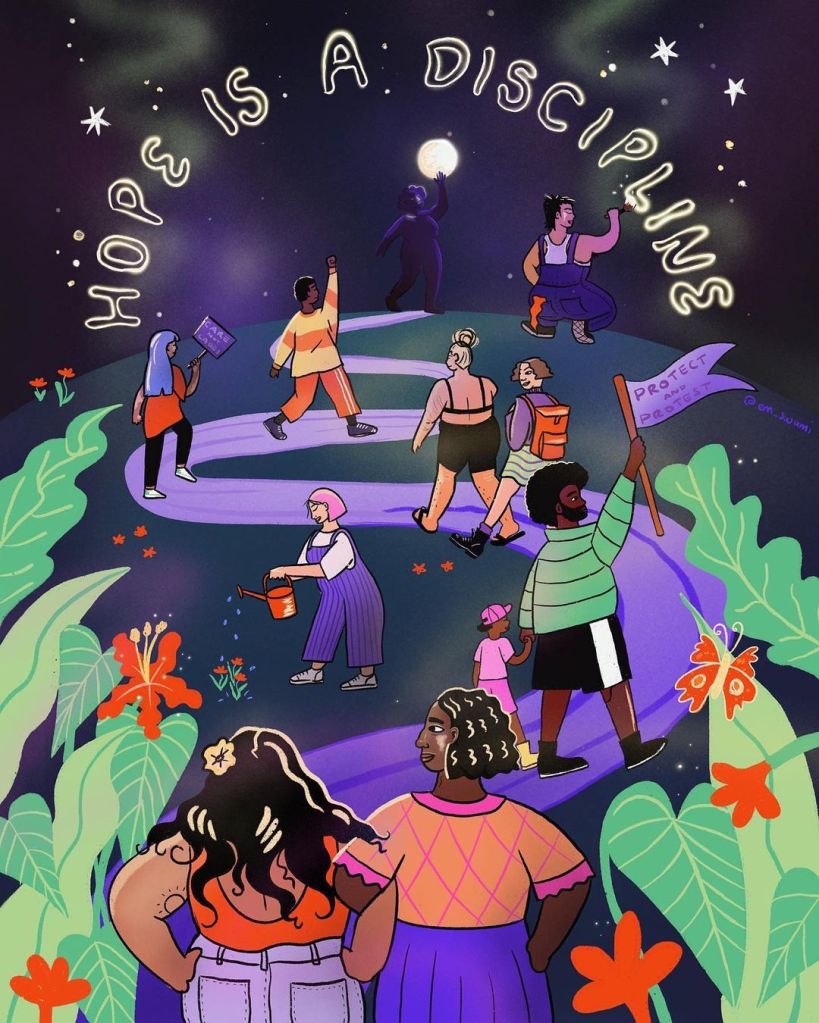
For some, hope can feel defeating. But the future exists in the practice of hope. We can begin—today—to live stories of hope; Planting metaphorical seeds for the future we want to see written. But to plant those seeds, we need the hope that they will grow, or else what’s the point?
Whether in the world of cancer or climate emergency, we can practice hope by engaging, choosing our actions with purpose, and becoming active in communities. We can have personal daily practices of mindfulness, presence, storytelling, and joyful connection. We can allow ourselves to fall in love, even though it may be painful. We can fall in love with every precious moment we get to spend among the trees.
Collected Resources
Creating deep community and why that matters:
Born, Paul. Deepening community: Finding joy together in chaotic times. Berrett-Koehler Publishers, 2014.
How does meaning emerge from grief and crisis:
Brody, Jane E., “Making Meaning Out of Grief.” New York Times, 2019.
Lee, Virginia, et al. “Meaning-making and psychological adjustment to cancer: development of an intervention and pilot results.” Oncology nursing forum. Vol. 33. No. 2. Oncology Nursing Society, 2006.
A psychosocial healing strategy offered to cancer patients:
Cunningham, Alastair J. Healing Journey. Key Porter Books, 1994.
The importance of meaning in adverse situations (and life in general):
Frankl, Viktor E. Man’s search for meaning. Simon and Schuster, 1985.
For more on biophilia, look at the work of Edward O. Wilson:
Kellert, Stephen R., and Edward O. Wilson, eds. The Biophilia Hypothesis. Island press, 1993.
On the causes of our problems and our interconnectedness:
Haraway, Donna. “Anthropocene, Capitalocene, Chthulucene: Staying with the Trouble.” AURA, 2014.
How appreciating the little things can add depth and meaning to life:
Hicks, Joshua, and Martela, Frank. “A New Dimension to a Meaningful Life.” Scientific American, 2022.
Speaking about different points at which we affect a system and make change:
Meadows, Donella H. “Leverage points: Places to intervene in a system.” (1999): 980989.
For lessons about turning toward suffering, welcoming everything, and showing up whole (as well as more on living fully):
Ostaseski, Frank. Five Invitations: Discovering What Death Can Teach Us About Living Fully. Pan Macmillan, 2017.
To read more about how problem- and meaning-focused teaching helps youth (and us) deal with climate change:
Ratinen, Ilkka. “Students’ Knowledge of Climate Change, Mitigation and Adaptation in the Context of Constructive Hope.” Education Sciences 11.3 (2021): 103.
About dealing with climate anxiety through communities of action:
Ray, Sarah Jacquette. “Op-Ed: Is Climate Anxiety Bad For the Planet.” Los Angeles Times, 2021.
Ray, Sarah Jaquette. “A Field Guide to Climate Anxiety.” A Field Guide to Climate Anxiety. University of California Press, 2020.
Different ways to look at and practice hope:
Tippet, Krista (host). “Future of Hope.” On Being, 2021.
On living life fully by escaping existential avoidance:
Van Tongeren, Daryl R., “The Problem of Existential Avoidance.” Psychology Today, 2020.
 Kat Dornian