Dark Days

Content warning: still about terminal cancer.

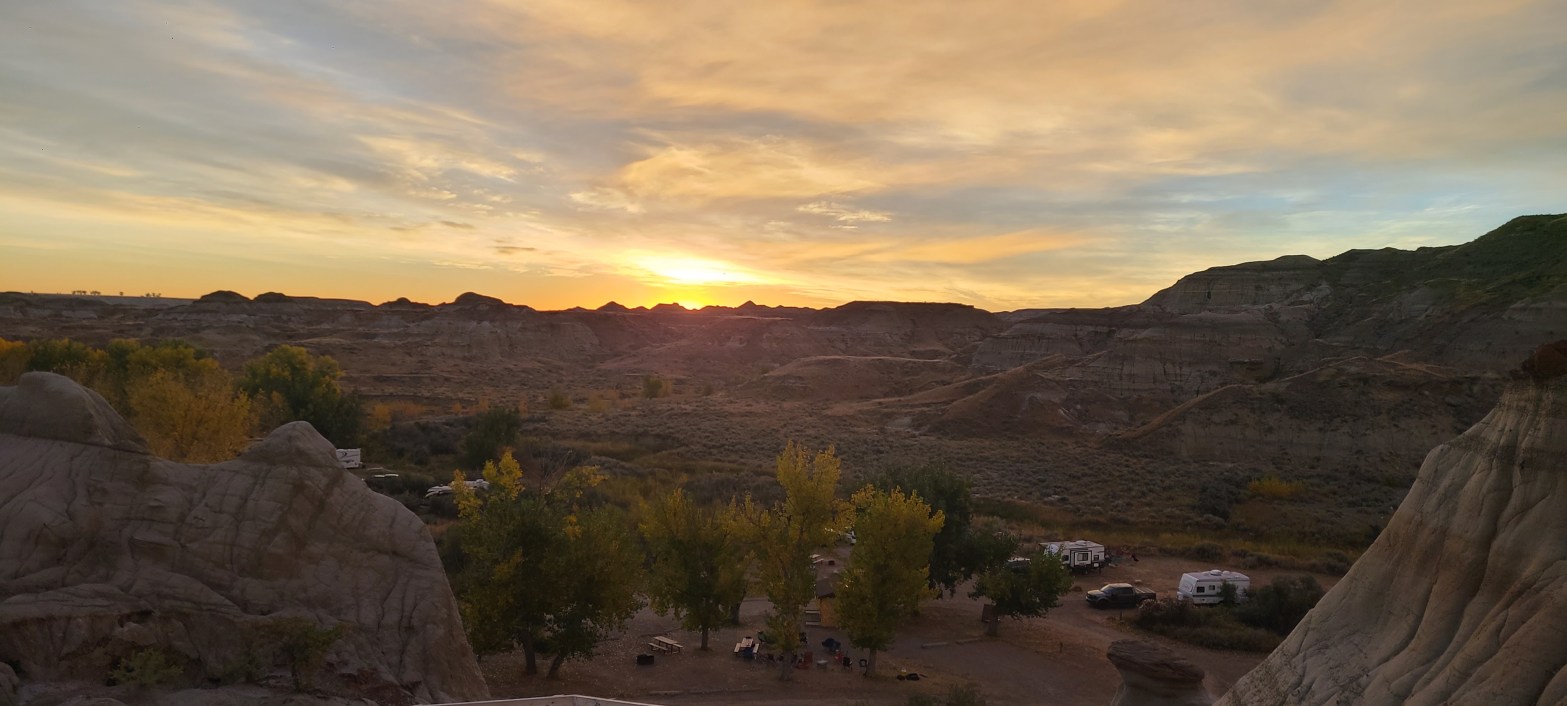
The dark is getting to me this year—persistent, cold, bitter. But, I’ll be damned if I let it stop me. One thing I know about the dark, is it must be faced. Not feared. Not ignored. Not fought. Not run from. And, for goodness sake, not given into.

That’s my weakness—giving in. I’m captivated by the dark. The stars, that milky stroke across the sky, the fleeting shadows, and the mystery draw me in. I could easily fall into the dark and let it consume me. Indeed, for much of the last four years I’ve had to hide in the dark to protect my skin, sanity, and immune system—staying away from sun and people.
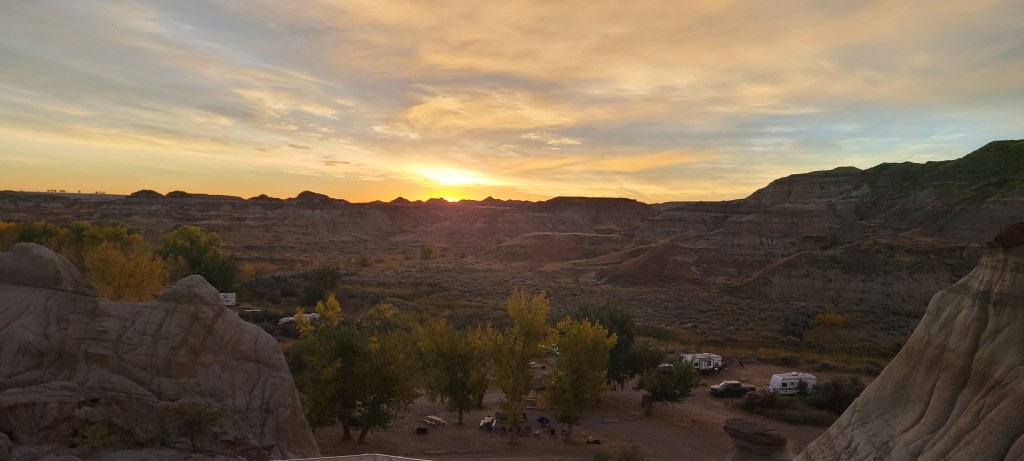
Rod and I went to Dinosaur Provincial Park in September.

A month ago, I sat in my doctor’s office and tears trickled down my cheeks, my breath caught in my throat, and sobs rang from my chest. I held my heart like a hug—a way to comfort myself. My onocologist handed me the tissue box. I’d just been told that the treatment I’m on usually extends survival by about 10 months. It’s a hard thing to hear. I’d just turned 39 and the laughter of my best friend’s first child still rang in my ears from the day before. There’s always light in the darkness, those stars that make the shadows flicker.

It’s not easy getting bad news as the nights grow longer and days become colder. There’s fewer activities to distract me and I’m forced to stay still, to nest… and ruminate. Furthermore, my new treatment makes me quite fatigued, which suits the 16 hour-long nights, but not keeping busy. Still, I get up the next day and make a grocery list because, goodness, I’ve dealt with everything else ad nauseam.

But this is what I’m talking about. I can give in too easy. I can plan so much for darkness that may never come (some darkness always does though). But my weakness is also my strength, because I can also plan for miserable things that need to be planned for. Not that I think death is miserable or dark, per se. But, to be honest, I still like life quite a lot and want to get the full experience—the good and bad, the sublime and imperfect, the light and dark—before I become dust and soil. And, so, I am looking at options. I may be going to the States next year for treatment, if I qualify. There’s a clinical trial coming to Calgary that may be a strong option for me.

And so, I dwell in the darkness of the season, for a bit. I go for walks when the low-hanging sun hits my face. I let stars guide me to new horizons and opportunities, being ready for what may come.

Still Here

It’s hard to believe I have cancer. Four years ago I had a port implanted in my chest and started chemotherapy. Four years later, I’m still here. I’m still on chemotherapy. It still feels surreal. Nonetheless, I am here.

I joked with my dermatologist that I’ve had cancer for as long as it takes to do an undergraduate degree. Although many of the feelings of grief, disbelief, wonder, and passion for living echo what I felt four years ago, there is also the journey I have been on and growth I have had in this time. Surprisingly, the hardest lessons have not been the innumerable drug names or what these drugs are doing or what all the different proteins and enzymes in my bloodwork are showing. The hardest lessons are what I’ve learned about cancer and the profound impacts of ableism on us—all of us. To this latter point, I’ll say that I still struggle with the ableist notions from which my understanding of the world grew, but I’m improving.

I’ve touched on my ableist belief system and my relationship with wellness culture before in my writing. Ableism is so ubiquitous and entrenched in society that it is a hard to shake. However, I’m becoming more adept at spotting ableist ideas and phrases now. This practice of spotting has allowed me to deepen my imagining of a world that’s possible if we treated disability differently.

I have much work to do toward this imagining. First, I must stop blaming myself for cancer. At least weekly, I see a post on social media or read an article or overhear a conversation where the individual with cancer is blamed for their cancer or rewarded for their remission: “if only they had been more healthy…”, “if only they had eaten better…”, “if only they had decided to do a complete 180 on their life to fight cancer…”. I understand how blame—or, to say it more gently, a cause and effect story—can give a sense of control and safety. And while I often think of myself as someone who is able to dwell in uncertainty, it is a draining practice. And so, I resort to ableism and the blaming of my imperfect body and my imperfect will: for skipping a workout, or eating a slice of cake, or staying out late for a few more songs to dance to.

I imagine, in a less ableist world, we see more grey areas—the magic in the liminal spaces—and are able to dwell in that uncertainty. We are not afraid of the vast differences in bodies and minds, allowing us to be gentler with “imperfections.” Perhaps we don’t use the words ‘perfection’ or ‘imperfection’ anymore. Perhaps, as our need for control gently dissolves, we see our connections to one another rather than the us-versus-them that’s awakened by fear and blame. Perhaps we feel our shared responsibility to care for our collective wellbeing. Cancer is not caused or reversed or worsened by the sole actions of an individual—it takes a community. It really does. And I am so thankful for mine.

For those who have stuck with me, thank you. Enough philosophizing; here’s an update of happenings since my last post to this site: I completed my creative writing certificate from the University of Calgary and am continuing to create and submit words. I pursued a liver transplant, but have decided that it is not right for me at this time. This is a tough decision to make; liver transplants do offer some patients many years of survival. However, recurrence rates are high (in my opinion), the surgery is risky, and I’d have more chronic health issues to manage for the rest of my life. I continued the chemotherapy treatment that caused skin irritation until June, at which point my health team and I decided it best to look at other treatments. Now, I am back on the chemotherapy regimen I had four years ago, with the hopes that it will be as effective as it was then and that the associated neuropathy holds off for a while. I also went to Iceland with my friend in March, which was an extraordinary adventure to an absolutely unique place. While travel was stressful for me, I somehow managed not to get sick and enjoy much of Icelandic culture and scenery.

I’m looking forward to the rest of 2025 and to being able to enjoy the outdoors a bit more now that my skin is not as sensitive to the sun. I’ll continue to write and learn (for another four years, at least, hopefully). And I’m continuing to look for emerging cancer treatments that might work for me; there are some promising therapies on the way to Canada, so stay tuned.

It’s hard to believe this is my life. It’s hard to accept my illness. But I’m getting better at that too!

References

Lorde, Audre. The cancer journals. Penguin, 2020.